
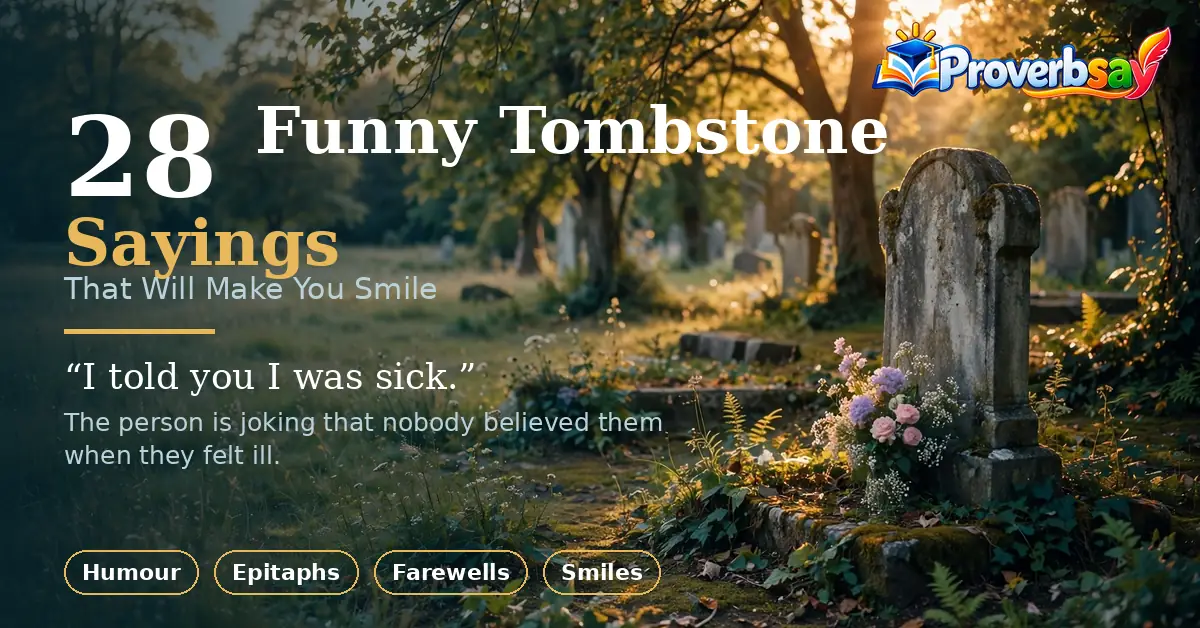
A funny tombstone saying is a last joke, carved in stone.
For hundreds of years, people have chosen light-hearted words for their headstones. A witty line can make a visitor smile, remember a loved one’s humour, and feel a little less sad.
In this guide, you will find 28 funny tombstone sayings, from famous real epitaphs to modern one-liners. Each one comes with its meaning, the joke explained, and advice on when it fits.
You will also learn why people choose humorous epitaphs, and how to pick one that is warm and respectful, never hurtful.
Quick Answer
Funny tombstone sayings are short, humorous lines written on headstones, also called epitaphs, that celebrate a person’s humour and make visitors smile. Below, you will find 28 funny tombstone sayings with meanings and examples, grouped by style, so you can enjoy the best ones and choose a respectful, light-hearted line if you ever need one.
What Is a Funny Tombstone Saying?
A funny tombstone saying is a short, humorous inscription on a grave marker or headstone.
The words on a headstone are called an epitaph. Most epitaphs are serious and loving. A funny epitaph adds humour to that love, often with a joke, a pun, or a gentle tease about the person’s life.
These sayings are not about mocking the dead. At their best, they honour the person’s character. A joke about a driver who loved speed, a baker who loved bread, or a teacher who loved quiet tells visitors who that person really was.
Some of the sayings in this guide are real epitaphs from actual graves. Others are modern sayings people share for headstones, cards, or Halloween displays. Where a saying comes from a real grave, we say so.
Why Do People Choose a Humorous Epitaph?
People choose a funny epitaph for several kind reasons.
First, it celebrates personality. A serious inscription could belong to anyone, but a witty line belongs to one person alone, and it keeps their humour alive.
Second, it comforts the living. Grief is heavy, and a smile at a graveside can ease it for a moment. Visitors often remember the funny line long after they forget the dates.
Third, it is often the person’s own choice. Many people plan their own epitaph, and they pick words that sound like them. A person who joked all their life would not want a dull, formal farewell.
Finally, humour can turn a sad visit into a warm memory. A grave that makes people smile is a grave that people visit with love, not only with sorrow.
Before choosing any funny line for a real headstone, always check two things: the family’s wishes, and the cemetery’s rules about length and wording. A joke that the whole family loves is a gift. A joke that surprises or upsets the family is not.
For more light-hearted sayings, see our collection of funny sayings.
Classic One-Liners
Some of the best funny epitaphs are a single short sentence. These six one-liners are famous, and each one says a lot in very few words.
1. “I told you I was sick.”
Meaning:
The person is joking that nobody believed them when they said they felt ill.
What It Really Means:
The humour comes from the idea of having the last word. The speaker warned everyone, nobody listened, and now the headstone proves them right. It is dry, gentle humour, the kind a person with a wry sense of fun would love.
Origin:
This is the real epitaph of the comedian Spike Milligan, on his headstone in England.
Example:
Visitors still smile when they read it, because it sounds exactly like something a stubborn, funny person would say.
When to Use It:
Use it for someone who loved dry humour and often joked about their own health, and only with the family’s full agreement.
Lesson:
A short, honest joke can capture a whole personality.
2. “Excuse my dust.”
Meaning:
The person is politely apologising for the dust of their grave, as if they were a guest in a tidy house.
What It Really Means:
The joke turns death into a small social moment. Instead of a grand farewell, the speaker offers a polite, almost shy apology. It is witty, modest, and very human.
Origin:
This is the real epitaph of the writer Dorothy Parker, famous for her sharp wit.
Example:
A visitor reading the line can almost hear her voice, polite and amused at the same time.
Lesson:
A polite joke can be warmer than a grand speech.
3. “That’s all folks!”
Meaning:
Life is over, just like a cartoon ending.
What It Really Means:
The line comes from the closing words of classic cartoons. It treats a life like a show that has reached its cheerful ending, with a wave goodbye instead of a sad farewell.
Origin:
This is the real epitaph of Mel Blanc, the voice of Bugs Bunny and many other cartoon characters.
Example:
Fans still visit his grave and smile, because the line fits the man who gave them so much laughter.
When to Use It:
Use it for someone who loved cartoons, comedy, or the world of entertainment.
Lesson:
A farewell that fits the person’s life is the best farewell of all.
4. “I’m not afraid to die, I just don’t want to be there when it happens.”
Meaning:
The person is not afraid of death itself, only of the moment it arrives.
What It Really Means:
The joke is honest and relatable. Almost everyone feels the same way, and putting that feeling on a headstone turns a common fear into a shared smile.
Origin:
This line comes from the comedian and writer Woody Allen, and people often quote it on headstones and memorial cards.
Example:
It works well as a line to share with friends, because it says something true in a funny way.
Lesson:
An honest joke about a shared fear can bring people comfort.
5. “Here lies an atheist, all dressed up and no place to go.”
Meaning:
The person did not believe in an afterlife, so they joke that they are dressed for a party that will never happen.
What It Really Means:
The humour is gentle and self-aware. It treats a serious belief with a light touch, and it tells visitors exactly what the person thought, without arguing about it.
Example:
It appears on real headstones and in collections of epitaphs, and readers smile at its calm confidence.
When to Use It:
Use it only for a person who held that belief openly and would have laughed at the line themselves.
Lesson:
A good epitaph tells the truth about the person, even with a joke.
6. “Gone, but not forgiven.”
Meaning:
The person has gone, but the joke says they are still not forgiven, a playful twist on the usual phrase “gone but not forgotten.”
What It Really Means:
The humour comes from flipping a familiar, loving phrase into a tease. It suggests a person who was loved, but who also enjoyed a good-natured argument, and whose friends are still pretending to hold a grudge.
Example:
Friends reading it can imagine the person laughing, because the line sounds like a final tease between old friends.
Lesson:
A familiar phrase with a small twist can make a very memorable epitaph.
Clever Wordplay and Puns
Wordplay is the heart of many funny epitaphs. A name, a job, or a habit becomes a pun, and the stone itself joins in the joke. These six sayings show how clever a few words can be.
7. “Here lies Johnny Yeast. Pardon him for not rising.”
Meaning:
Johnny Yeast was a baker, and the joke is that he cannot “rise” like bread dough.
What It Really Means:
The pun works on two meanings of “rise.” Bread rises in the oven, and a dead person rises no more. The line is gentle, not harsh, because it celebrates the man’s trade with a smile.
Origin:
This is a real epitaph, recorded in collections of humorous headstones.
Example:
Visitors who know a little about baking laugh at once, and even those who do not soon work out the joke.
When to Use It:
Use it as inspiration for a pun based on the person’s own job or hobby.
Lesson:
A pun that fits the person’s work is the cleverest kind of epitaph.
8. “Here lies Lester Moore, four slugs from a .44, no Les, no more.”
Meaning:
Lester Moore was shot four times, and the joke turns his name “Les” into “less,” meaning “no Les, no more.”
Origin:
This is a real epitaph from Boothill Graveyard in Arizona, where the gunfighter Lester Moore is buried.
Example:
It is one of the most photographed headstones in America, because the rhyme and the wordplay are so neat.
Lesson:
Rhyme and wordplay together make an epitaph hard to forget.
9. “Here lies an honest lawyer, and that is Strange.”
Meaning:
The lawyer was named Strange, and the joke is that an honest lawyer is a strange, surprising thing.
What It Really Means:
The pun turns on the man’s surname. “That is Strange” means both “that is odd” and “that is Mr. Strange.” It is a gentle tease about lawyers, not a harsh attack.
Origin:
This is the real epitaph of John Strange, a lawyer, recorded in old collections of epitaphs.
Example:
Lawyers and law students still enjoy it, because the joke is fair and the wordplay is perfect.
Lesson:
A person’s own name can be the best material for a witty epitaph.
10. “Gone away, owin’ more than he could pay.”
Meaning:
Owen Moore has gone away, still owing more money than he could pay.
What It Really Means:
The joke is a rhyme on the name “Owen” and the word “owin’,” short for “owing.” It is a light-hearted admission of debt, told with a smile instead of shame.
Origin:
This is a real epitaph for a man named Owen Moore, recorded in collections of humorous headstones.
Example:
Readers smile because the rhyme is so natural that the joke feels like it wrote itself.
When to Use It:
Use it as an example of a name rhyme, or for someone who joked about money themselves.
Lesson:
A rhyme on a name can turn an ordinary fact into a lasting joke.
11. “Here lies a man named Frost who did insist on lying on his tombstone.”
Meaning:
A man named Frost insisted on lying down on his tombstone, which is also where his body lies.
What It Really Means:
The pun turns on the word “lying.” It means both resting on the stone and telling an untruth. The joke is that the man was stubborn even about his own grave.
Origin:
This saying appears in old collections of funny epitaphs, and it is often quoted as a classic of the form.
Example:
It works best when read aloud, because the listener hears the double meaning at once.
Lesson:
One word with two meanings can carry a whole joke.
12. “I’d rather be reading this.”
Meaning:
The person would rather be reading the headstone than lying under it.
Origin:
This line is recorded as the epitaph of Esther A. Freer, and it appears in many modern collections of funny headstone quotes.
Example:
Book lovers smile at it at once, because it describes exactly how they would feel.
When to Use It:
Use it for a keen reader, a librarian, a teacher, or anyone who loved books.
Lesson:
An epitaph that names the person’s true love is always a good choice.
Funny Epitaphs About Work and Professions
A person’s job often shapes their humour. An epitaph about work can celebrate a lifetime of skill, and these five sayings show how.
13. “Here lies the body of Jonathan Blake, stepped on the gas instead of the brake.”
Meaning:
Jonathan Blake died in a driving accident, because he pressed the accelerator instead of the brake.
What It Really Means:
The joke is dark, but it is also honest and direct. It tells the story of the accident in a single rhyming line, with no blame and no sadness, only a plain account of what happened.
Origin:
This is a real epitaph, widely quoted in collections of funny headstones.
Example:
Visitors remember it because the rhyme makes the sad story easy to retell, and the plain words keep it gentle.
Lesson:
A short, rhyming account can be kinder than a long, formal one.
14. “Here lies the body of Daniel Saul, Spitalfields weaver — and that’s all.”
Meaning:
Daniel Saul was a weaver from Spitalfields, and that is all there is to say about him.
What It Really Means:
The humour is in the plainness. After a grand opening, “Here lies the body of,” the epitaph ends with a shrug: he was a weaver, and that is all. It is modest, funny, and oddly touching.
Origin:
This is a real epitaph, recorded in an old book of epitaphs from English churchyards.
Example:
Readers smile because the ending is so short and so honest, and it suits a plain working man.
Lesson:
Sometimes the plainest words are the funniest, and the most honest.
15. “Here lies a teacher who finally got a quiet classroom.”
Meaning:
The teacher has finally found peace and quiet, after years of noisy classrooms.
What It Really Means:
The joke is warm, not bitter. Every teacher knows the noise of a full classroom, and the idea of a quiet one at last is both funny and peaceful.
Example:
It works well on a memorial card for a teacher, or on a Halloween tombstone for a school display.
Lesson:
A joke about the daily reality of a job feels personal and true.
16. “Here lies a gardener, now pushing up daisies.”
Meaning:
The gardener is now buried under the ground, where daisies grow.
What It Really Means:
“Pushing up daisies” is a cheerful old saying for being buried. The joke fits a gardener perfectly, because the person who grew flowers all their life is now part of the garden.
Example:
It is a popular line for gardeners, and it appears on real headstones as well as on Halloween props.
Lesson:
A familiar saying becomes special when it fits the person’s life.
17. “Here lies a fisherman who finally caught the big one.”
Meaning:
The fisherman has at last caught the biggest fish of all, which is death itself.
What It Really Means:
The joke is gentle and hopeful. Fishermen tell stories about “the big one” that got away, and this line says the wait is over at last.
Example:
It suits a memorial for an angler, and it also works on a Halloween tombstone near a pond or a lake.
Lesson:
A hobby the person loved is a safe and happy subject for a funny epitaph.
Rhyming Epitaphs
Rhyming epitaphs are easy to remember, and they were popular in old churchyards. These five rhymes have survived for centuries because they are funny, neat, and easy to repeat.
18. “Here lies the body of our Anna, done to death by a banana.”
Meaning:
Anna died after eating a banana, or rather, after slipping on its skin.
What It Really Means:
The full rhyme says it was not the fruit that laid her low, but the skin of the thing that made her go. The humour is in the small, silly cause of death, told in a cheerful rhyme.
Origin:
This is a real epitaph for Anna Hopewell, quoted in many collections of funny headstones.
Example:
Children and adults alike remember it, because the rhyme is so neat and the story is so surprising.
When to Use It:
Use it as an example of a rhyming epitaph, or for a Halloween display, rather than for a real grave.
Lesson:
A good rhyme can make even a sad story feel light.
19. “Underneath this pile of stones, lies all that’s left of Sally Jones.”
Meaning:
Under this pile of stones lies all that is left of Sally Jones, whose name was really Lord, not Jones.
What It Really Means:
The full rhyme explains that her name was Lord, not Jones, but Jones was used to rhyme with stones. The joke is honest about itself: the writer chose a rhyme over the truth.
Origin:
This saying appears in old collections of funny epitaphs, and it is often quoted as a classic.
Example:
Readers laugh because the writer admits the trick in the very next line.
Lesson:
Admitting the joke inside the joke can make it even funnier.
20. “Under the sod and under the trees lies the body of Jonathan Pease.”
Meaning:
Jonathan Pease lies buried under the grass and the trees, and he has “shelled out” and gone to God.
What It Really Means:
The full rhyme says he is not here, there is only the pod, because Pease shelled out and went to God. The pun turns on “Pease” and “peas,” and on “shelled out,” which means both leaving a pea pod and leaving life.
Origin:
This is a real epitaph from a Nantucket tombstone, quoted in collections of humorous epitaphs.
Example:
It is a favourite with visitors, because the pea pun is so neat and the rhyme is so complete.
Lesson:
A surname pun, told in rhyme, is one of the oldest tricks in funny epitaphs.
21. “Here lies William Shaw, an attorney-at-law — if he is not blest, what will become of all the rest?”
Meaning:
William Shaw was a lawyer, and the joke asks what hope the rest of us have if even he is not blessed.
Origin:
This is a real epitaph from an old English churchyard, recorded in a book of epitaphs.
Example:
Lawyers enjoy it, because it praises the man while teasing his profession.
Lesson:
A joke that praises the person while teasing the job is the warmest kind.
22. “On a Thursday I was born, on a Thursday made a bride, on a Thursday broke my leg, and on a Thursday died.”
Meaning:
Every big event in this woman’s life happened on a Thursday, including her death.
What It Really Means:
The humour is in the pattern. Birth, marriage, an accident, and death all fell on the same weekday, and the rhyme lists them like a diary. It is funny because life rarely follows such a neat pattern.
Origin:
This is a real epitaph, recorded in an old book of epitaphs from English churchyards.
Example:
Readers smile at the rhythm of the four Thursdays, and at the calm way the writer lists her whole life.
Lesson:
A simple list of a life’s big days can be both funny and touching.
Light-Hearted Farewells
These six sayings are farewells with a smile. They say goodbye in a light, warm way, and they suit a person who faced life with humour.
23. “The good die young.”
Meaning:
Good people die young, says the saying, but this headstone belongs to a man who lived to 102.
Origin:
This is the real epitaph of Ezekial Aikle, who died at the age of 102.
Example:
Visitors laugh when they read the dates, because the joke only works when you see how old he was.
When to Use It:
Use it for someone who lived a long, full life, and who would have enjoyed the joke.
Lesson:
A well-known saying can become a joke when the facts prove it wrong.
24. “Was hoping for a pyramid, but this will do.”
Meaning:
The person hoped for a grand pyramid as a tomb, but this simple headstone will do.
What It Really Means:
The humour is in the gap between the dream and the reality. A pyramid is grand and impossible, and a plain stone is modest and real. The line accepts the modest stone with a smile.
Example:
It appears on modern headstones and in collections of funny epitaphs, and readers enjoy its cheerful modesty.
Lesson:
A joke about a grand dream can make a simple grave feel special.
25. “I’m not snoring, I’m dead.”
Meaning:
The person is not asleep and snoring; they are dead.
What It Really Means:
The joke plays on the idea that a dead person looks asleep. It is short, direct, and funny, because it answers a question nobody would really ask.
Example:
It is a popular line for Halloween tombstones, and it also appears on real headstones for people with a dry sense of humour.
Lesson:
A very short joke can be the most memorable one.
26. “I finally stopped speeding.”
Meaning:
The person has at last stopped driving fast.
What It Really Means:
The humour is gentle and self-aware. It suggests a person who loved speed and knew it, and who can now joke about the habit that may have ended their life.
Example:
It appears in collections of funny headstone quotes, and drivers smile at it at once.
Lesson:
A joke about your own habit is warmer than a joke about someone else’s.
27. “Here lies the dust of Margaret Gywn, who was so very pure within, that she chipp’d the shell of her earthly skin, and hatch’d herself a cherubim.”
Meaning:
Margaret Gywn was so pure inside that she broke out of her earthly body like a chick from an egg, and became an angel.
Origin:
This is a real epitaph from a churchyard in Cambridgeshire, England, recorded in an old book of epitaphs.
Example:
Readers enjoy it because the image is so sweet and so unusual, and because it praises the woman warmly.
Lesson:
A beautiful image can make an epitaph funny, kind, and memorable all at once.
28. “I always said I’d sleep when I’m dead. Now’s my chance.”
Meaning:
The person always said they would sleep when they were dead, and now they finally can.
What It Really Means:
The joke is about a busy life. People who work hard often say they will rest later, and this line says that later has finally arrived. It is funny because it is true for so many hard workers.
Example:
It suits a memorial for a busy, hard-working person, and it also works on a Halloween tombstone.
Lesson:
A joke about a busy life can be a warm farewell for a hard worker.
How to Choose a Funny Tombstone Saying Respectfully
Choosing a funny epitaph is a kind act when it is done well, and a hurtful one when it is done badly. Follow these steps to get it right.
First, think about the person, not the joke. The best funny epitaph sounds like something that person would actually say. If the line does not fit their humour, choose a different one.
Second, ask the family. A funny line should make the family smile, not wince. If even one close family member dislikes it, choose something gentler.
Third, check the cemetery’s rules. Many cemeteries limit the length of an inscription, and some do not allow humour at all. Ask before you carve anything in stone.
Fourth, keep it short. The funniest epitaphs are one or two lines. A long joke is hard to carve, hard to read, and easy to misunderstand.
Fifth, keep it kind. A joke about the person’s own habits, job, or hobbies is safe. A joke about someone else, or about a painful event, is not.
Finally, read it aloud. If it sounds warm and funny when spoken, it will read well on stone. If it sounds harsh or confusing, rewrite it.
For more sayings about life and wisdom, see our guide to 50 proverbs with meaning.
Common Mistakes to Avoid
Funny epitaphs are easy to get wrong, so watch for these mistakes.
- Choosing a joke the person would not have liked. The epitaph should honour the person, not amuse strangers. If they were a serious person, a funny line may feel wrong.
- Forgetting the family. A joke that amuses friends can still hurt a grieving widow, parent, or child. Ask the family first, always.
- Making the joke too long. A headstone is not a noticeboard. One or two short lines are enough, and longer lines are hard to read from a distance.
- Using humour that mocks the dead. A joke about the person’s own habits is warm. A joke that laughs at their death, their faith, or their appearance is not.
- Copying a famous epitaph without thinking. “I told you I was sick” is perfect for Spike Milligan, but it may not fit your loved one. Choose a line that fits the person, not the fame.
- Ignoring cemetery rules. Some cemeteries refuse humorous inscriptions, or limit the number of words. Check the rules before you pay for carving.
Frequently Asked Questions
Is it disrespectful to put a funny saying on a tombstone?
No, it is not disrespectful when the saying fits the person and the family agrees. A funny epitaph celebrates a person’s humour and can comfort visitors. It becomes disrespectful only when it mocks the dead, upsets the family, or makes light of a painful death. Always ask the family first.
How long should a funny epitaph be?
A funny epitaph should be short, usually one or two lines, or under fifteen words. Short lines are easier to carve, easier to read from a distance, and easier to remember. Long jokes lose their humour on stone, and many cemeteries also limit the number of characters allowed.
Can any cemetery accept a humorous inscription?
No, not every cemetery accepts humour. Some cemeteries have strict rules about wording, length, and tone, and a few allow only traditional inscriptions. Always check the cemetery’s rules before choosing a funny line, and get the wording approved in writing if you can.
What is the most famous funny epitaph?
The most famous funny epitaph is Spike Milligan’s “I told you I was sick,” carved on his headstone in England. Dorothy Parker’s “Excuse my dust” is another favourite. Both lines are loved because they are short, witty, and true to the person who chose them.
How do I write my own funny epitaph?
Start with something true about your life: your job, your hobby, or a habit your friends tease you about. Turn it into one short line, with a pun or a rhyme if you can. Read it aloud, keep it kind, and ask your family whether it makes them smile.
Conclusion
Funny tombstone sayings remind us that humour does not have to end at the grave.
The 28 sayings in this guide range from famous one-liners to rhyming churchyard verses. Each one shows how a few witty words can celebrate a life, comfort the living, and keep a person’s character alive.
If you ever choose a funny epitaph, keep it short, keep it kind, and make sure it sounds like the person it honours. A joke chosen with love is a farewell worth carving in stone.
And if you only came here to smile, we hope these 28 sayings did just that.

Liam Derren is a passionate writer who shares insightful ideas, practical tips, and valuable information to help readers stay informed, explore new perspectives, and make smarter decisions.