
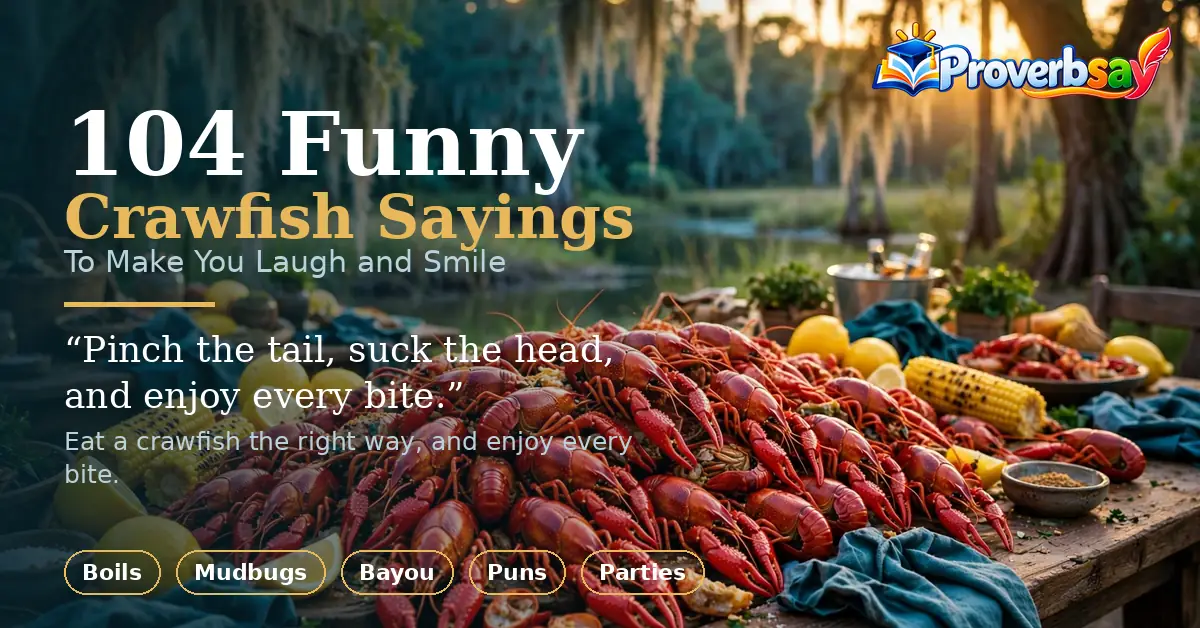
Funny crawfish sayings are the sound of Louisiana on a warm evening. The pot is boiling, the spice is in the air, and someone is already reaching for the next tail.
Crawfish, also called mudbugs, are small, red, and full of character. They pinch, walk backwards, and turn an ordinary supper into a party.
In this guide, you will find 104 funny crawfish sayings of our own, grouped by theme, each with a clear meaning, a natural example, and a small lesson.
Quick Answer
Funny crawfish sayings are short, playful lines about crawfish boils, mudbugs, bayou life, and seafood puns, built around lines like “pinch the tail, suck the head.” Below, you will find 104 original funny crawfish sayings with meanings, examples, and lessons, grouped by theme.
What Makes a Crawfish Saying Funny?
A crawfish saying is funny when it takes one small crawfish habit and turns it into a joke we all recognise. The best lines use the boil, the pinch, the shell, or the bayou.
A crawfish is funny because it looks serious and acts silly. It walks backwards, waves its claws like a tiny boxer, and still ends up as the star of dinner.
The table below shows the three things that make a crawfish saying work.
| What makes it funny | Why it works | Example in this guide |
|---|---|---|
| A true crawfish habit | Readers nod because every crawfish does the same thing | A crawfish that pinches first and asks later |
| A small surprise | The ending turns in a way you did not expect | A crawfish that guards its plate like treasure |
| A human voice for the crawfish | The crawfish sounds like a chef, a coach, or a party guest | A crawfish that orders its own boil |
A good crawfish saying is also short. One clear picture is enough.
If you enjoy short, funny sayings grouped by theme, our guide to funny southern sayings uses the same clear style for more Southern humour.
The Crawfish Boil Is On
The boil is where every crawfish story begins. The water bubbles, the spice rises, and the neighbourhood knows dinner is coming.
1. The pot is boiling, and the crawfish are ready to party.
Meaning:
The crawfish boil has started, and the fun is about to begin.
What It Really Means:
The picture is simple: a big pot bubbling over a fire. The deeper message is that a boil is not just cooking; it is the start of a party that brings everyone together.
Example:
The pot started to bubble, and the neighbours drifted over with chairs.
When to Use It:
Use it when the boil starts and the guests begin to gather.
Lesson:
Start the party with a full pot, and the guests will come on their own.
2. A crawfish boil is not a meal; it is a celebration.
Meaning:
A crawfish boil is a happy gathering, not just a way to eat.
Example:
The family invited the whole street, and the boil lasted until dark.
Lesson:
Turn a meal into a celebration, and everyone will remember it.
3. When the water boils, the whole town shows up.
Meaning:
The smell and sound of a boil draw the whole neighbourhood in.
Example:
The pot had barely started when cousins and neighbours filled the yard.
Lesson:
Good food and good company are the best invitations.
4. The crawfish boil starts when the first pot hits the fire.
Meaning:
The party truly begins the moment the cooking pot goes on the fire.
Example:
He set the pot on the burner, and the children cheered like it was a holiday.
Lesson:
Begin with the first step, and the rest of the fun will follow.
5. A good boil needs good friends and plenty of spice.
Meaning:
The two things that make a boil great are friends and flavour.
Example:
She added extra spice, called her best friends, and the evening turned perfect.
Lesson:
Mix good friends with good flavour, and any meal becomes a feast.
6. The crawfish are red, the corn is sweet, and the day is perfect.
Meaning:
Everything at the boil is just right: the crawfish, the corn, and the day.
Example:
The corn was sweet, the crawfish were red, and nobody wanted to leave.
Lesson:
Enjoy a perfect day while it lasts, and thank the cook.
7. At a crawfish boil, nobody leaves hungry or unhappy.
Meaning:
A boil feeds everyone well and leaves them in a good mood.
Example:
Even the picky eaters went back for seconds and left smiling.
Lesson:
Feed people well, and they will leave happy.
8. The boil is ready when the smell makes the whole street smile.
Meaning:
You know the boil is done when its spicy smell reaches the whole street.
Example:
The neighbours followed the smell to the yard and asked what was cooking.
Lesson:
A good smell is the best dinner bell.
9. A crawfish boil turns strangers into friends by the second plate.
Meaning:
Sharing a boil quickly makes strangers feel like old friends.
Example:
The new neighbour arrived shy, and by his second plate he was laughing.
Lesson:
Share food with strangers, and friendship will follow fast.
10. The secret of a great boil is patience, spice, and good company.
Meaning:
A great boil needs time, flavour, and people you enjoy.
Example:
He waited for the water, seasoned it well, and the evening turned grand.
Lesson:
Be patient, season well, and keep good company.
11. When the crawfish hit the table, the talking stops and the eating starts.
Meaning:
Once the crawfish are served, everyone stops chatting and starts eating.
Example:
The platter landed on the table, and the yard went quiet except for happy chewing.
Lesson:
Serve the food hot, and the talk can wait.
12. A crawfish boil is the South’s way of saying welcome.
Meaning:
In the South, a boil is how people show guests they are welcome.
Example:
The family held a boil the week the new neighbours moved in.
Lesson:
Welcome people with food, and they will feel at home.
13. The best parties are the ones with a pot full of crawfish.
Meaning:
A party with a big pot of crawfish is hard to beat.
Example:
The party had music and cake, but the boil was what everyone talked about.
Lesson:
Keep the pot full, and the party will take care of itself.
Pinch the Tail, Suck the Head
“Pinch the tail, suck the head” is the golden rule of eating crawfish. It sounds odd to newcomers, but to Louisiana folk it is natural.
14. Pinch the tail, suck the head, and enjoy every bite.
Meaning:
Eat a crawfish the right way: pinch the tail meat out, then taste the head.
Example:
The old fisherman showed the boy how to pinch the tail, and he grinned.
Lesson:
Learn the right way to enjoy a good thing, and it tastes better.
15. Pinch the tail first, and the rest takes care of itself.
Meaning:
Start with the tail, and the rest of the crawfish is easy to eat.
Example:
She pinched the first tail, and soon her plate was empty and her fingers were hot.
Lesson:
Start with the first step, and the rest will follow.
16. Suck the head if you dare; that is where the flavour lives.
Meaning:
The head holds the rich, spicy juices that give the crawfish its bold taste.
Example:
The brave guest tried the head, laughed, and reached for another crawfish.
Lesson:
Be brave and try the best part, even if it looks strange.
17. The tail is the prize, but the head holds the secret.
Meaning:
The tail meat is the main treat, but the head hides the deepest flavour.
Example:
He ate the tail first, then sipped the head and nodded.
Lesson:
Look for the hidden secret, not only the obvious prize.
18. Pinch, peel, and pop it in — that is the crawfish way.
Meaning:
The quick three steps of eating a crawfish are pinch, peel, and eat.
Example:
The children learned the rhythm fast: pinch, peel, pop, and repeat.
Lesson:
Learn the simple steps, and the job becomes easy.
19. A crawfish tail is small, but the joy is huge.
Meaning:
A tiny tail holds a surprisingly big amount of pleasure.
Example:
One small tail made the little girl clap and ask for more.
Lesson:
Do not judge joy by size; small things can delight you most.
20. The head holds the spice, so do not skip it.
Meaning:
The spicy juices sit in the head, so skipping it means missing the best flavour.
Example:
The cook warned the guests not to skip the head, and they thanked him.
Lesson:
Do not skip the best part of a good thing.
21. Pinch the tail gently, or you will wear the juice.
Meaning:
Pinch too hard and the spicy juice will splash on your clothes.
Example:
He squeezed the tail too hard, and the juice landed on his shirt.
Lesson:
Handle good things gently, or they will make a mess.
22. The first crawfish is the hardest; after that, your hands know the way.
Meaning:
The first crawfish takes practice, but your hands learn the trick quickly.
Example:
The visitor fumbled with the first one, then peeled the next ten fast.
Lesson:
The first try is the hardest; keep going and your hands will learn.
23. Suck the head, lick your fingers, and ask for more.
Meaning:
Eating crawfish properly means enjoying every drop and wanting another.
Example:
She finished the head, licked her fingers, and held out her plate again.
Lesson:
Enjoy a good meal fully, and do not be shy about seconds.
24. A crawfish without spice is like a party without music.
Meaning:
Spice is what makes a crawfish worth eating, just as music makes a party.
Example:
The bland batch sat untouched until the cook added more seasoning.
Lesson:
Add flavour to your work, or no one will remember it.
25. The tail meat is sweet, and the head juice is bold.
Meaning:
The tail is mild and sweet, while the head brings the bold, spicy taste.
Example:
He ate the sweet tail first, then tasted the bold head.
Lesson:
Enjoy both the gentle and the bold parts of life.
26. Pinch the tail, suck the head, and pass the napkins.
Meaning:
Eating crawfish is messy fun, so keep the napkins close.
Example:
The table was covered in shells and napkins, and everyone was laughing.
Lesson:
Share the mess and the laughter, and pass the napkins around.
Mudbug Puns and Wordplay
Crawfish puns write themselves. Shell, claw, pinch, boil, and tail all sound like something else.
27. I am not shellfish; I am just saving the best crawfish for myself.
Meaning:
The joke plays on “selfish” and “shellfish” to excuse keeping the best crawfish.
Example:
He hid the biggest crawfish under the corn and grinned.
Lesson:
Share a joke about sharing, and everyone will laugh.
28. This party is claw-some, thanks to the crawfish.
Meaning:
The party is awesome, with a pun on “claw.”
Example:
The host held up a crawfish claw, and the guests cheered.
Lesson:
A good pun can lift the whole party.
29. I am feeling a little shell-shocked after that boil.
Meaning:
The eater is stunned by the spice and the feast, with a pun on “shell-shocked.”
Example:
After three plates, he sat back and said he needed a rest.
Lesson:
Enjoy a feast, but know when to stop and rest.
30. Crawfish make me happy; they really spice up my day.
Meaning:
Crawfish lift the mood, with a pun on spice.
Example:
She arrived tired, ate two plates, and left smiling.
Lesson:
A little spice can turn an ordinary day into a good one.
31. You are my main squeeze, said the lemon to the crawfish.
Meaning:
The lemon calls the crawfish its main squeeze, with a pun on squeezing lemons.
Example:
The cook squeezed a lemon over the pot and winked at the guests.
Lesson:
A squeeze of lemon and a kind word both make things better.
32. I told the crawfish a joke, and it was clawing with laughter.
Meaning:
The crawfish laughed so hard it clawed the air, with a pun on “clawing.”
Example:
The boy told a joke at the boil, and the whole table laughed.
Lesson:
Tell a joke at the table, and the meal tastes better.
33. This crawfish is un-boil-ievably good.
Meaning:
The crawfish is unbelievably good, with a pun on “boil.”
Example:
The guest took one bite and asked for the recipe at once.
Lesson:
When something is truly good, say so out loud.
34. I am in a pinch, so pass me another crawfish.
Meaning:
The eater is in a pinch and needs another crawfish, with a pun on “pinch.”
Example:
His plate was empty, so he asked for more and got cheers.
Lesson:
Ask for what you need, and do it with a smile.
35. Shell we have another boil this weekend?
Meaning:
“Shall we” becomes “shell we” in this invitation to another boil.
Example:
The friends finished the last plate and planned the next boil.
Lesson:
Plan the next good time while the last one is still warm.
36. The crawfish said, “I am too hot to handle, and too tasty to share.”
Meaning:
The crawfish brags that it is spicy and delicious, so no one wants to share it.
Example:
The guest held up the reddest crawfish and joked it was all his.
Lesson:
Enjoy the best bite, but remember to share the pot.
37. My love for crawfish is off the shell.
Meaning:
The love is off the charts, with a pun on “shell.”
Example:
She drove two hours just for a boil, and nobody was surprised.
Lesson:
Follow what you love, even if it takes a long drive.
38. The crawfish crossed the road to get to the boil.
Meaning:
The crawfish crossed the road because the boil was waiting on the other side.
Example:
The boy saw a crawfish near the road and joked it smelled the spice.
Lesson:
Follow the good smell, and you will find the party.
39. I am not crabby; I am just craving crawfish.
Meaning:
The speaker is not grumpy; he only wants crawfish, with a pun on “crabby” and “craving.”
Example:
He woke up hungry and said he needed a boil, not a nap.
Lesson:
Name what you really want, and the mood will lift.
Crawfish Jokes and One-Liners
These one-liners are quick, silly, and easy to remember. Tell one at the boil, and the whole table will laugh.
40. Why did the crawfish wear a tiny hat? It wanted to look sharp for the boil.
Meaning:
The crawfish dressed up to look its best for the party.
Example:
The child put a paper hat on a toy crawfish and laughed.
Lesson:
Dress up for the party, even if the party is a boil.
41. What did the crawfish say to the corn? “We make a great pair in this pot.”
Meaning:
The crawfish and the corn are a perfect pair in the boiling pot.
Example:
The cook tossed in the corn, and the guests said the pair was perfect.
Lesson:
Good pairs make a meal better, so choose your partners well.
42. Why did the crawfish take a nap? It was steamed after a long day.
Meaning:
The crawfish was tired and steamed, with a pun on being cooked.
Example:
After the long boil, the cook sat down and said he was steamed.
Lesson:
Rest after hard work, and do not be shy about it.
43. What do you call a crawfish who loves gossip? A pinch of trouble.
Meaning:
A gossiping crawfish is a small pinch of trouble, with a pun on “pinch.”
Example:
The old neighbours shared the news, and the street knew by supper.
Lesson:
A little gossip spreads fast, so keep it kind.
44. Why did the crawfish hide behind the potato? It did not want to be the next course.
Meaning:
The crawfish hid from the cook behind the potato in the pot.
Example:
The child pointed at the potato and joked the crawfish was hiding there.
Lesson:
Hide from trouble when you can, and laugh about it later.
45. What did the crawfish say when the water got hot? “Well, this is a fine kettle of trouble.”
Meaning:
The crawfish found itself in hot water, with a pun on the kettle.
Example:
The cook laughed as the water bubbled, and the guests joined in.
Lesson:
Laugh when things heat up, and the trouble feels smaller.
46. Why did the crawfish bring a fan to the boil? It wanted to stay cool under pressure.
Meaning:
The crawfish brought a fan to stay cool in the hot pot.
Example:
The guest fanned himself in the heat and joked he was the crawfish.
Lesson:
Stay cool under pressure, and bring your own fan if you must.
47. What is a crawfish’s favourite sport? Pinch-pong.
Meaning:
The crawfish loves ping pong, with a pun on “pinch.”
Example:
The children played table tennis after the boil and called it pinch-pong.
Lesson:
Turn a game into a joke, and everyone will want to play.
48. How does a crawfish say goodbye? “I will see you at the next boil.”
Meaning:
The crawfish promises to meet again at the next boil.
Example:
The friends waved goodbye and promised to meet at next month’s boil.
Lesson:
Say goodbye with a promise to meet again.
49. Why did the crawfish guard its plate? It believed in keeping its friends close and its tails closer.
Meaning:
The crawfish guards its tails closely, with a joke on keeping friends close.
Example:
He held his plate tight and joked his tails were too good to share.
Lesson:
Guard what you love, but share it with true friends.
50. What did the crawfish say to the shrimp? “You may be small, but I am the star of this boil.”
Meaning:
The crawfish tells the shrimp that it is the star of the boil.
Example:
The shrimp sat beside the crawfish, and the cook welcomed both.
Lesson:
Let every guest shine, even when you are the star.
51. Why did the crawfish laugh at the chef? The chef dropped the spice and blamed the pot.
Meaning:
The chef made a mistake and blamed the pot, which made the crawfish laugh.
Example:
The chef spilled the seasoning, laughed, and added a little more.
Lesson:
Own your mistakes with a laugh, and keep cooking.
52. What do you call a sleepy crawfish? A slow boiler.
Meaning:
A sleepy crawfish boils slowly, with a pun on “slow boiler.”
Example:
The tired guest yawned and said he was a slow boiler too.
Lesson:
Rest when you are tired, and boil at your own pace.
Life on the Bayou
The crayfish, known in Louisiana as the crawfish or mudbug, is a small freshwater creature that has become a symbol of Southern food and fun. On the bayou, it is not just dinner; it is a way of life.
53. Life on the bayou moves slow, like a crawfish in no hurry.
Meaning:
Bayou life is slow and calm, just like a crawfish.
Example:
The old man sipped his coffee and watched the water drift by.
Lesson:
Slow down sometimes, and enjoy the water going by.
54. A bayou morning starts with fog, coffee, and a crawfish trap.
Meaning:
A typical bayou morning begins with mist, a hot drink, and checking the traps.
Example:
At dawn, the fisherman checked his traps with a warm cup.
Lesson:
Start the day with a simple routine, and it will ground you.
55. The crawfish knows the bayou better than any map.
Meaning:
The crawfish knows every bend and pool of the bayou by heart.
Example:
The guide said the crawfish always find the coolest water in summer.
Lesson:
Trust those who know the place best, not only the map.
56. On the bayou, a crawfish is never just dinner; it is a neighbour.
Meaning:
Bayou folk treat the crawfish as part of their home, not only as food.
Example:
The children named the crawfish in the pond and visited them daily.
Lesson:
Respect the creatures that share your home, even the ones you eat.
57. The bayou teaches patience, and the crawfish teaches it best.
Meaning:
Waiting on the bayou builds patience, and the slow crawfish is the best teacher.
Example:
The boy waited an hour for the trap, and his grandfather smiled.
Lesson:
Wait patiently, and the bayou will reward you.
58. A crawfish in the bayou walks backwards and still gets home.
Meaning:
A crawfish moves backwards yet still finds its way home.
Example:
The little crawfish scuttled back to its hole as the boat passed.
Lesson:
Your path may look backwards, but it can still lead you home.
59. The mud on the bayou is where the crawfish feels most at home.
Meaning:
The crawfish loves the soft bayou mud, its natural home.
Example:
The crawfish buried itself in the mud and stayed cool all afternoon.
Lesson:
Feel at home where you belong, even if it looks muddy to others.
60. Bayou folk say a crawfish can smell a good boil from a mile away.
Meaning:
People joke that a crawfish can sense a boil from far away.
Example:
The neighbours arrived before the pot even boiled, drawn by the spice.
Lesson:
Good news travels fast, especially when food is involved.
61. The bayou sun sets slow, and the crawfish boil lasts long.
Meaning:
Evenings on the bayou are long and slow, just like the boil.
Example:
The sun sank slowly while the family ate, talked, and laughed.
Lesson:
Let good evenings last long, and do not rush them.
62. A crawfish trap in the bayou is a promise of a good supper.
Meaning:
Setting a trap means a tasty supper is on its way.
Example:
He set three traps in the morning and promised the family a feast.
Lesson:
Set your traps early, and supper will take care of itself.
63. On the bayou, everyone knows the crawfish by name — well, almost.
Meaning:
Bayou folk joke that they know every crawfish, though there are far too many.
Example:
The fisherman greeted the pond like an old friend and laughed.
Lesson:
Greet your neighbours warmly, even the ones with too many names.
64. The bayou gives the crawfish its home, and the crawfish gives the bayou its flavour.
Meaning:
The bayou shelters the crawfish, and the crawfish gives the bayou its taste and fame.
Example:
The town’s best dish came from the bayou’s mud and its crawfish.
Lesson:
Give and take fairly, and both sides will grow richer.
65. A quiet bayou evening and a pot of crawfish are all a person needs.
Meaning:
Simple pleasures — a calm evening and a good pot — are enough for happiness.
Example:
After a hard week, he sat by the water with a pot and felt peace.
Lesson:
Keep your needs simple, and happiness will come easily.
Crawfish Sayings for Captions and Cards
These short lines are made for photos, cards, and party posts. Pick one, add a photo, and let the crawfish talk.
66. Pinch me, I am at a crawfish boil.
Meaning:
The eater can hardly believe he is at a real crawfish boil.
Example:
I posted this line with a photo of my first plate at the boil.
Lesson:
Share your joy online, and friends will want to join you.
67. Keep calm and boil on.
Meaning:
Stay calm and keep boiling, with a twist on a famous slogan.
Example:
I wrote this on a card for a friend planning a big boil.
Lesson:
Stay calm, keep cooking, and the party will be fine.
68. Born to boil, forced to share.
Meaning:
The crawfish was born for the boil, but sharing is part of the deal.
Example:
I used this caption for a photo of my plate piled high.
Lesson:
Share the best bites, even when you want them all.
69. Just a small-town kid who loves crawfish and good spice.
Meaning:
A simple caption from someone who loves crawfish boils.
Example:
I posted this with a photo of my hometown boil, and old friends liked it.
Lesson:
Own your simple joys, and share them proudly.
70. Crawfish season is my favourite season.
Meaning:
Of all the seasons, crawfish season is the best one.
Example:
I wrote this on a spring card and sent it to my whole family.
Lesson:
Mark your favourite season, and celebrate it every year.
71. Eat, pinch, repeat.
Meaning:
The three-step rhythm of a boil: eat, pinch, and do it again.
Example:
I captioned my boil photo with this line, and friends asked for it.
Lesson:
Find a happy rhythm, and repeat it often.
72. Life is better with a little spice and a lot of crawfish.
Meaning:
Life improves with flavour and a generous pot of crawfish.
Example:
I sent this line to my brother before his first boil.
Lesson:
Add spice to life, and share it generously.
73. I came, I saw, I pinched the tail.
Meaning:
A playful twist on a famous saying, about conquering the crawfish plate.
Example:
I wrote this under a photo of my empty plate after the boil.
Lesson:
Take on a fun challenge, and finish the plate with pride.
74. Come for the crawfish, stay for the company.
Meaning:
People come for the food, but the friends around the table are the real reason they stay.
Example:
Our boil invitation said it best: come for the crawfish, stay for the company.
Lesson:
Plan the food, but treasure the people it brings together.
75. My happy place smells like a crawfish boil.
Meaning:
The smell of a boil is the writer’s idea of happiness.
Example:
I used this line on a card for a friend who moved away.
Lesson:
Remember the smells that make you happy, and visit them often.
76. Squeeze the lemon, pinch the tail, live a little.
Meaning:
Enjoy life’s small pleasures: lemon, crawfish, and a little fun.
Example:
I captioned my sunset boil photo with this line, and it got likes.
Lesson:
Live a little every day, and enjoy the small pleasures.
77. Crawfish and sunshine: the perfect pair.
Meaning:
Crawfish and sunny weather belong together.
Example:
I posted this with a photo of our boil on a bright afternoon.
Lesson:
Pair good food with good weather, and the day is made.
78. Let the good times boil.
Meaning:
Let the fun begin, with a pun on “roll” and “boil.”
Example:
I used this line on a party invitation for a backyard boil.
Lesson:
Start the fun with a warm welcome, and everyone will join in.
Crawfish Party and Festival Sayings
A crawfish festival is a whole town in party mode. The bands play, the pots boil, and nobody stays a stranger.
79. A crawfish festival is a party where everyone is family.
Meaning:
At a festival, even strangers are treated like family.
Example:
The visitor was handed a plate and a chair within minutes.
Lesson:
Treat every guest like family, and the party will grow.
80. At the festival, the crawfish are the guests of honour.
Meaning:
The crawfish are the stars of the festival, honoured above all else.
Example:
The festival poster showed a giant crawfish wearing a crown.
Lesson:
Honour the star of the show, and the show will shine.
81. The band plays, the pots boil, and the whole town dances.
Meaning:
Music, food, and dancing fill the whole town during the festival.
Example:
The band struck up a tune, and the crowd danced between the pots.
Lesson:
Mix music, food, and dancing, and a town becomes a party.
82. A crawfish festival turns a small town into a big family.
Meaning:
The festival brings a whole small town together like one large family.
Example:
The small town welcomed five thousand visitors, and all ate together.
Lesson:
Open your town to visitors, and it will feel like family.
83. Come hungry, leave happy — that is the festival rule.
Meaning:
The only rule at the festival is to arrive hungry and leave smiling.
Example:
The sign at the gate read, “Come hungry, leave happy,” and everyone obeyed.
Lesson:
Arrive ready to enjoy, and leave with a smile.
84. The festival starts with a boil and ends with a smile.
Meaning:
The festival begins with cooking and ends with happy faces.
Example:
By sunset, the pots were empty and the crowd was still smiling.
Lesson:
Begin with good food, and end with good memories.
85. At a crawfish festival, seconds are a tradition, not a choice.
Meaning:
Going back for a second plate is expected at a festival.
Example:
The cook laughed and said seconds were part of the ticket price.
Lesson:
Go back for seconds when the food is good, and enjoy it fully.
86. The best seat at the festival is next to the boil pot.
Meaning:
Sitting by the pot means the freshest crawfish and the best stories.
Example:
The old-timers always sat by the pot, telling tales between plates.
Lesson:
Sit near the source of the fun, and you will never miss out.
87. A crawfish festival is where new friends are made over old recipes.
Meaning:
Festivals turn strangers into friends while sharing traditional recipes.
Example:
Two cooks swapped family recipes, and their families became friends.
Lesson:
Share your recipes, and you will make new friends.
88. Dance first, eat second, and nap after the boil.
Meaning:
The festival order is dance, then eat, then rest.
Example:
The children danced to the band, ate two plates, and napped.
Lesson:
Enjoy the fun first, the food second, and rest last.
89. The festival queen wears a crown, and the crawfish wear the spice.
Meaning:
The queen wears a crown while the crawfish wear their spicy red coats.
Example:
The queen waved from the float as the pots steamed behind her.
Lesson:
Let everyone shine in their own way, queen or crawfish.
90. A crawfish festival proves that simple food makes the best memories.
Meaning:
Simple festival food creates memories that last longer than fancy meals.
Example:
Years later, the family still talked about the festival boil, not the restaurant.
Lesson:
Keep food simple, and the memories will stay rich.
91. When the festival ends, the stories about the boil live on.
Meaning:
After the festival, people keep telling stories about the boil for years.
Example:
The grandfather still tells the tale of the biggest crawfish he ate.
Lesson:
Tell the story well, and the party will never truly end.
Crawfish Wisdom With a Laugh
Behind every funny crawfish line, there is a small lesson. The mudbug teaches patience, courage, and good timing.
92. A crawfish walks backwards, yet it always moves forward in life.
Meaning:
A crawfish moves backwards, but it still makes progress in life.
Example:
She took a step back, learned a new skill, and came back stronger.
Lesson:
Do not fear a step back; it can still move you forward.
93. The crawfish teaches us that small things can pack a big punch.
Meaning:
A tiny crawfish carries a surprisingly strong flavour and a sharp pinch.
Example:
The smallest crawfish had the boldest spice, and everyone noticed.
Lesson:
Never judge power by size; small things can surprise you.
94. Like a crawfish, keep your shell strong and your heart soft.
Meaning:
Be tough on the outside to protect yourself, and kind on the inside.
Example:
The nurse stayed firm with the rules and gentle with the patients.
Lesson:
Protect yourself with a strong shell, and keep your heart soft.
95. A crawfish never hurries, and it still reaches the pot on time.
Meaning:
The slow crawfish still arrives exactly when it is needed.
Example:
The old fisherman moved slowly, yet his traps were full by noon.
Lesson:
Move at your own pace, and you will still arrive on time.
96. The crawfish hides in the mud, but it shines on the table.
Meaning:
The crawfish lives quietly in the mud, then becomes the star at dinner.
Example:
The shy cook stayed in the kitchen, yet her boil won the prize.
Lesson:
Shine when your moment comes, even if you hid in the mud before.
97. Be like a crawfish: tough on the outside, sweet on the inside.
Meaning:
A crawfish has a hard shell and sweet meat, a good model for life.
Example:
The strict teacher had a hard manner but a kind heart.
Lesson:
Be tough when you must, and sweet when it counts.
98. A crawfish does not chase the pot; the pot comes to it.
Meaning:
The crawfish waits calmly, and the cook comes to fetch it.
Example:
She waited patiently for the job offer instead of chasing every lead.
Lesson:
Wait with calm confidence, and good things will come to you.
99. The crawfish reminds us to enjoy the spice of life.
Meaning:
The crawfish teaches us to welcome flavour and excitement in life.
Example:
He added hot sauce to his eggs and said life was too short for bland.
Lesson:
Add spice to your days, and life will taste better.
100. A crawfish sheds its shell to grow, and so should we.
Meaning:
A crawfish must leave its old shell behind to grow bigger, just as we must leave old habits.
Example:
She left her old job, learned new skills, and grew into a better role.
Lesson:
Shed old habits to grow, even when it feels uncomfortable.
101. The crawfish may be small, but its flavour fills the whole room.
Meaning:
A small crawfish has a taste so bold that the whole room notices it.
Example:
One pot filled the house with a smell that made everyone hungry.
Lesson:
Make your presence felt, no matter how small you are.
102. Like the crawfish, hold on tight when life gets hot.
Meaning:
When trouble heats up, hold on firmly like a crawfish’s claw.
Example:
During the hard year, she held on to her savings and family, and both survived.
Lesson:
Hold on tight in hot times, and you will come through.
103. A crawfish in hot water still keeps its cool — well, almost.
Meaning:
The crawfish stays calm in the hot pot, at least until the very end.
Example:
The cook joked that the crawfish stayed cool until the water bubbled.
Lesson:
Stay cool in hot water, and laugh at the heat.
104. The crawfish’s last lesson: enjoy the boil, and share the table.
Meaning:
The final lesson is simple: enjoy the feast and share it with others.
Example:
At the end of the night, the family shared the last plate and laughed.
Lesson:
Enjoy the feast, and always share the table.
How to Use Funny Crawfish Sayings
These sayings work best when they fit the moment. Use them to make a friend smile, to caption a photo, or to add humour to a party.
In a caption, pick one saying that matches the photo. A boiling pot needs a boil saying, and a festival crowd needs a festival saying.
One good line is better than five lines that do not fit.
In a card, add one saying and one real memory of your own boil or bayou visit.
In conversation, say the line lightly, like a joke you share with a friend. Do not explain it too much.
For more sayings in the same funny style, see our collection of funny pirate sayings for more themed jokes and puns.
Common Mistakes to Avoid
- Using a boil joke at a formal dinner. A crawfish joke belongs at a boil, a picnic, or a casual party, not at a formal meal. Match the joke to the mood of the room.
- Claiming a famous quote you cannot verify. Do not put a famous name on a funny line unless you are sure of the words and the author. An original saying with no name is safer than a wrong attribution.
- Explaining the pun until the joke dies. A pun works when it lands fast. If you have to explain “shellfish” twice, the laugh is gone. Say it once, smile, and move on.
- Posting a photo with a saying that does not match it. A boil saying under a photo of a quiet pond confuses the reader. Match the line to what the photo actually shows.
- Overusing puns until the joke gets tired. One crawfish pun in a caption is charming. Five puns in one message are too many. Use the best line, and leave the rest for another day.
Frequently Asked Questions
What is the funniest crawfish saying for a caption?
A short line that matches the photo works best, such as “Pinch me, I am at a crawfish boil.” Pick a saying that describes what your crawfish are doing in the picture, and keep the caption to one line plus a short note of your own.
Are these funny crawfish sayings original?
Yes. The sayings in this guide were written for this article, based on everyday crawfish boils, bayou life, and Southern food culture. They are not copied from other websites, and no famous names are attached to them.
A few old ideas, like “pinch the tail, suck the head,” come from folk wisdom.
How do you eat crawfish the right way?
Hold the crawfish with both hands, twist off the tail, pinch the tail meat out, and eat it. If you like spice, suck the juices from the head. Peel a few first to learn the trick, and keep napkins close because it gets messy.
When is crawfish season?
Crawfish season in Louisiana usually runs from late winter through spring, with the best and biggest crawfish in March, April, and May. The season depends on the weather and the water, so a cold spring can delay the peak by a few weeks.
What is the best funny crawfish saying for kids?
A simple play saying fits children best, such as “Why did the crawfish wear a tiny hat? It wanted to look sharp for the boil.” Kids love silly hats, loud boils, and proud crawfish, so pick a line about dressing up, hiding, or a happy festival.
Conclusion
Crawfish make us laugh because they are small, bold, and completely sure of themselves.
These 104 funny crawfish sayings catch that humour in short, simple lines, each from a real habit that Louisiana folk see every day.
Choose one saying that fits your boil right now. Share it with a friend, use it as a caption, or read it aloud and smile.
Your crawfish may not laugh, but it will probably pinch, scuttle backwards, and take full credit for the party.
For more classic proverbs grouped by theme, explore our 50 proverbs with meaning collection.

Liam Derren is a passionate writer who shares insightful ideas, practical tips, and valuable information to help readers stay informed, explore new perspectives, and make smarter decisions.