
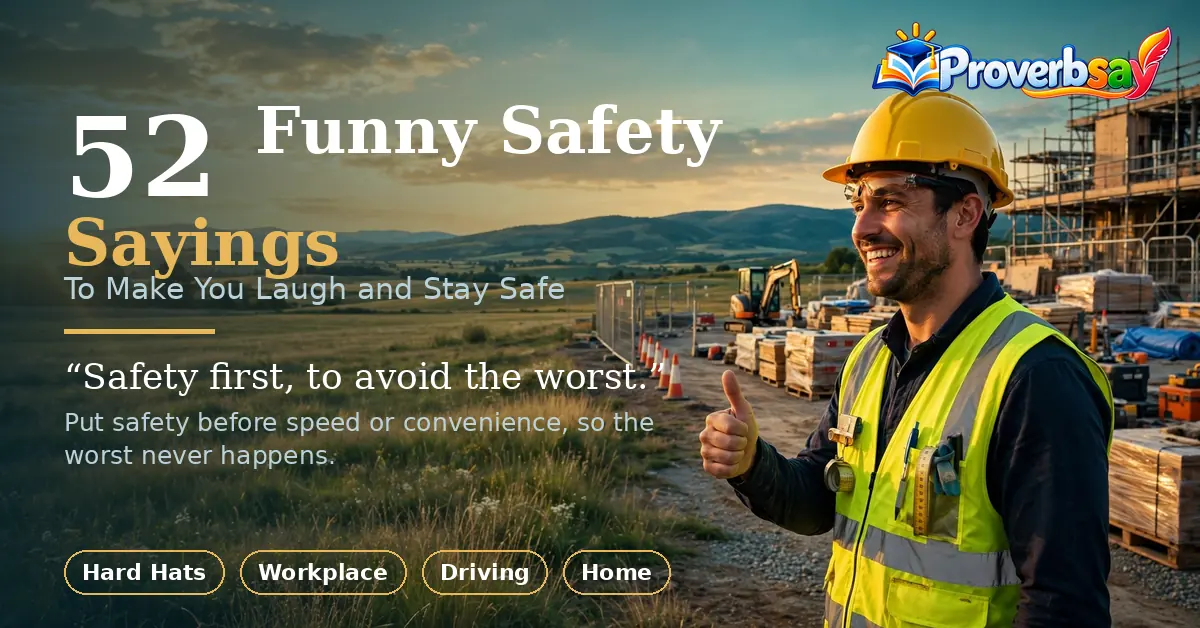
A funny safety saying can make a serious message stick.
Most safety rules are easy to forget. A short, funny line is much harder to forget, because the laugh helps the lesson stay in your mind.
In this guide, you will find 52 funny safety sayings with clear meanings, natural examples, and a practical lesson for each one. The sayings are grouped by theme, so you can find the right line for the workplace, the road, or home.
If you enjoy light-hearted lines in general, you will also like our wider collection of funny sayings.
You will also learn why humour works for safety messages, how to use these sayings, and which mistakes to avoid.
Quick Answer
Funny safety sayings are short, witty lines that turn a safety rule into a joke people remember. Below, you will find 52 of them, grouped by theme, each with a meaning, an example, and a lesson. They work best on posters, in toolbox talks, and in training, where a quick laugh opens the door to a serious message.
What Are Funny Safety Sayings?
A funny safety saying is a short, well-known line that makes a safety rule easier to remember by adding humour.
Most of these sayings have no known author. They grew out of workplaces, safety posters, and training rooms, and workers passed them on because they worked. Never attach a famous name to one, because the words belong to no single writer.
Humour works for safety messages for a simple reason. A joke catches attention, so the rule that follows it has a better chance of being heard. A poster that makes people smile is read far more often than a poster that only lists rules.
These sayings are used in many places: on workplace posters, at the start of toolbox talks, in safety training, on T-shirts, and in social media posts.
In every case, the joke is only the hook. The real message is the safe habit behind it.
The table below shows how a funny safety saying differs from a plain rule and from a joke.
| Type | What it is | Example |
|---|---|---|
| Funny safety saying | A witty line that teaches a safety habit | Don't learn safety by accident. |
| Safety rule | A direct instruction that must be followed | Wear your hard hat on site. |
| Joke | A funny line with no safety lesson | Why did the scarecrow win an award? |
For wise lines with a deeper lesson, see our guide to 50 proverbs with meaning.
Funny Safety Sayings for General Workplace Safety
Safety starts with attitude. These ten sayings remind everyone that safe habits come first, every day.
1. Safety first, to avoid the worst.
Meaning:
Put safety before speed or convenience, so the worst never happens.
Example:
The team stopped work to fix a loose guard rail instead of rushing to finish the job. Safety first, to avoid the worst, their supervisor said.
Lesson:
Make safety the first choice, not the last thought.
2. No safety, know pain. Know safety, no pain.
Meaning:
Without safety, you will learn about pain; with safety, you will avoid it.
What It Really Means:
The joke plays on two words that sound alike: "no" and "know". The first half warns that ignoring safety teaches a hard lesson through injury. The second half promises the opposite: knowing safety means no pain.
Example:
He skipped his gloves to save a minute and cut his hand on a sharp edge. No safety, know pain, his colleague said as she handed him a bandage.
When to Use It:
Use it in training or on a poster where workers are tempted to skip protective steps.
Lesson:
Learn safety from teaching, not from an injury.
3. Working safely may get old, but so do those who practice it.
Meaning:
Safe habits may feel boring, but they are what let workers grow old.
Example:
He followed every safety check for thirty years and retired in good health. Working safely may get old, but so do those who practice it.
Lesson:
Boring habits are worth it when they give you a long life.
4. Don't learn safety by accident.
Meaning:
Do not wait for an accident to teach you why safety matters.
Example:
The new worker asked why the machine needed a guard, and the trainer smiled. Don't learn safety by accident, he said, and showed her how the guard worked.
Lesson:
Learn the rule before the job starts, not after something goes wrong.
5. Chance takers are accident makers.
Meaning:
People who take chances with safety are the ones who cause accidents.
Example:
He stood on a chair to reach a high shelf instead of fetching a ladder, and the chair tipped over. Chance takers are accident makers, his manager said.
Lesson:
Refuse the gamble; use the safe method instead.
6. Safety doesn't happen by accident.
Meaning:
Safe workplaces are built by planning and care, not by luck.
Example:
The site had no injuries for a full year, not because it was lucky, but because the team checked everything daily. Safety doesn't happen by accident.
Lesson:
Plan safety in; never leave it to luck.
7. Safety first, because injuries last.
Meaning:
Injuries can affect you for months or years, so safety must come first.
Example:
A back injury from one careless lift kept him off work for six months. Safety first, because injuries last, he tells every new worker.
Lesson:
One careless minute can cost many painful months.
8. Safety first is safety always.
Meaning:
Safety is not a one-time choice; it applies every hour of every day.
Example:
She wore her safety glasses for a two-minute job as well as for a full day's work. Safety first is safety always, she said.
Lesson:
Keep the same care on the last job of the day as on the first.
9. Safety isn't expensive, it's priceless.
Meaning:
Safety may cost money, but its value is far greater than any price.
Example:
The company bought better gloves for the whole team, and the manager called it the best decision of the year. Safety isn't expensive, it's priceless.
Lesson:
Spend a little on safety now, and save far more later.
10. Safety first, drama later.
Meaning:
Deal with safety first, and save the excitement for another time.
Example:
When a colleague wanted to race the forklifts, the team leader shook his head. Safety first, drama later, he said, and the race never happened.
Lesson:
Keep the job calm; save the fun for after work.
Funny Safety Sayings About Hard Hats and PPE
Protective gear only works when people wear it. These eight sayings make helmets, glasses, gloves, and ear protection feel less like a burden.
11. Safety glasses: all in favor, say eye!
Meaning:
Everyone should agree to wear safety glasses, because your eyes are at risk.
What It Really Means:
The joke is a pun on "aye" and "eye". In a meeting, people vote by saying "aye" to agree. Here, the saying asks for eyes instead, because safety glasses protect the very thing you vote with.
Example:
Before cutting metal, the trainer held up a pair of safety glasses. Safety glasses: all in favor, say eye! The whole team laughed and put theirs on.
When to Use It:
Use it before a job that throws dust, sparks, or small pieces into the air.
Lesson:
Protect your eyes; you only get one pair.
12. Hard hats: because your head isn't a test dummy.
Meaning:
Wear a hard hat, because your head cannot survive a test impact.
Example:
A small tool slipped from the scaffold and bounced off his hard hat. Hard hats: because your head isn't a test dummy, he said, tapping the dent in the helmet.
Lesson:
Wear the hard hat; let it take the hit, not your head.
13. Hearing protection is a sound investment.
Meaning:
Ear protection is a wise purchase, because it saves your hearing.
What It Really Means:
The joke plays on "sound", which means both noise and something wise. Ear defenders protect you from sound, and buying them is a sound, sensible decision at the same time.
Example:
The workshop was loud enough to make conversation impossible, so she handed out ear defenders. Hearing protection is a sound investment, she said.
When to Use It:
Use it in a noisy workshop, factory, or building site, or on a poster near ear protection supplies.
Lesson:
Protect your hearing now, or you will miss it later.
14. Keep calm and wear your PPE.
Meaning:
Stay calm, and put on your personal protective equipment.
Example:
The new worker felt rushed on his first day, so his mentor smiled and pointed at the gear rack. Keep calm and wear your PPE, he said.
Lesson:
Calm hands put the gear on; rushed hands skip it.
15. Falling objects can be brutal if you don't protect your noodle.
Meaning:
Things that fall from above can hurt you badly if you do not protect your head.
Example:
A hammer fell two floors and landed on a hard hat with a loud crack. Falling objects can be brutal if you don't protect your noodle, the worker said, feeling very glad he was wearing one.
Lesson:
Wear your hard hat wherever anything could fall.
16. Dress for the slip, not for the trip.
Meaning:
Choose clothes and shoes for safe footing, not for looking good on a journey.
Example:
She swapped her smooth shoes for grippy work boots before walking across the wet floor. Dress for the slip, not for the trip, she laughed.
Lesson:
Wear shoes that grip; fashion can wait until after work.
17. Safety is like a lock, but you are the key.
Meaning:
Safety equipment and rules are the lock, but only you can make them work.
Example:
The machine had a safety guard, but it only helped when the worker switched it on. Safety is like a lock, but you are the key, the trainer reminded him.
Lesson:
Use the safety gear; it cannot protect you by itself.
18. Protect your hands — you need them to pick up your paycheck.
Meaning:
Look after your hands, because you need them to work and earn your pay.
Example:
Before handling sharp sheet metal, he pulled on thick gloves. Protect your hands — you need them to pick up your paycheck, he joked.
Lesson:
Gloves on first; your hands earn your living.
Funny Safety Sayings About Slips, Trips and Falls
Most falls start with something small: a spill, a loose cable, or a moment of not looking. Falls are one of the most common causes of injury in occupational safety and health, and these seven sayings turn that everyday risk into a line people remember.
19. A spill, a slip, a hospital trip.
Meaning:
A spilled liquid can cause a slip, and a slip can end in hospital.
What It Really Means:
The rhyme links three steps in a chain. A spill is the start, a slip is the result, and a hospital trip is the price. Cleaning up quickly breaks the chain at the first step.
Example:
Someone knocked over a drink in the corridor, and a cleaner wiped it up at once. A spill, a slip, a hospital trip, she said, and nobody fell.
When to Use It:
Use it in kitchens, corridors, and work areas where liquids are handled.
Lesson:
Clean a spill at once; never walk past it.
20. Keep safety in mind — it will save your behind.
Meaning:
Think about safety, and it will protect you from a painful fall.
Example:
He paused to check the wet floor sign before crossing the lobby. Keep safety in mind — it will save your behind, he joked to his colleague.
Lesson:
Watch where you walk, especially on wet floors.
21. Your mom doesn't work here — clean up after yourself.
Meaning:
Nobody else will clean up your mess, so tidy up your own work area.
Example:
He left cables across the walkway and walked away, until a colleague called out. Your mom doesn't work here — clean up after yourself, she said, and he coiled the cables away.
Lesson:
Leave the area tidy for the next person.
22. Be aware, know where.
Meaning:
Pay attention to your surroundings, and always know where you are walking.
Example:
The warehouse floor had pallets, trolleys, and cables everywhere, so she slowed down and looked ahead. Be aware, know where.
Lesson:
Look ahead before you step ahead.
23. Be alert, don't get hurt.
Meaning:
Stay alert, and you will avoid injuries.
Example:
He nearly stepped into an open floor hatch while reading a message, then stopped himself in time. Be alert, don't get hurt, he muttered, and put the phone away.
Lesson:
Eyes up, phone down, when you are moving.
24. When in doubt, check it out.
Meaning:
If you are unsure whether something is safe, stop and check before you continue.
Example:
The floor looked dry, but a faint shine made her pause and test it with her foot. When in doubt, check it out, she said, and found a thin patch of oil.
Lesson:
A ten-second check beats a ten-week recovery.
25. Safety is as simple as ABC: Always Be Careful.
Meaning:
Safety is easy to understand: always be careful, in every job.
What It Really Means:
The saying turns safety into three letters anyone can remember. "A" stands for always, "B" for be, and "C" for careful. Together, they mean care is an every-time habit, not a sometimes habit.
Example:
Before crossing the busy loading bay, the driver slowed down and looked both ways. Safety is as simple as ABC: Always Be Careful, he said to the new starter beside him.
When to Use It:
Use it in training for new workers, or on a poster where people need a rule they can recall in seconds.
Lesson:
Make "always be careful" your default setting.
Funny Safety Sayings About Ladders and Working at Heights
Height forgives no mistakes. These six sayings keep the humour light while the message stays serious: check the ladder, hold on, and never rush.
26. While on a ladder, never step back to admire your work.
Meaning:
Never step backwards on a ladder to look at what you have done.
Example:
He finished painting the top of the wall and felt tempted to step back for a better look. While on a ladder, never step back to admire your work, he remembered, and climbed down instead.
Lesson:
Admire the work from the ground, not from the ladder.
27. Warning: gravity always wins.
Meaning:
Gravity never takes a day off, so a fall from height always ends badly.
Example:
A worker leaned too far from a platform to reach a bolt, and his mate grabbed his belt in time. Warning: gravity always wins, his mate said, and they moved the platform.
Lesson:
Respect gravity; work within your reach.
28. Working safely is like breathing — if you don't, you die.
Meaning:
Safe work is as essential as breathing, because without it, you may not survive.
Example:
Before climbing the tower, the engineer checked his harness twice, even though he had done it a hundred times. Working safely is like breathing — if you don't, you die, he said quietly.
Lesson:
Treat every safety check as essential, not optional.
29. Those who work the safest way live to see another day.
Meaning:
Workers who follow the safest method are the ones who come back tomorrow.
Example:
The roofing team took the slow, safe route every time, even when the quick route looked tempting. Those who work the safest way live to see another day, their foreman said.
Lesson:
Choose the safe route, even when it is slower.
30. Life is short — practice safety so you don't rush it.
Meaning:
Life is brief already, so do not make it shorter by rushing unsafe work.
Example:
He was tempted to skip tying off his harness to save five minutes, then stopped himself. Life is short — practice safety so you don't rush it, he thought, and tied off properly.
Lesson:
Slow down at height; five saved minutes are never worth a fall.
31. Don't text and lift.
Meaning:
Never look at your phone while lifting or moving a load.
Example:
He tried to answer a message while carrying a heavy box up the stairs, and the box slipped. Don't text and lift, his colleague said, as they steadied the load.
Lesson:
Put the phone away until the load is safely down.
Funny Safety Sayings About Driving and Road Safety
The road is no place for jokes that distract, but a funny line remembered before the journey can save a life. These six sayings are for drivers and pedestrians alike.
32. Never drive faster than your guardian angel can fly.
Meaning:
Never drive so fast that even your guardian angel cannot keep up with you.
What It Really Means:
The saying pictures a guardian angel flying beside the car. If the car goes too fast, the angel falls behind, and the driver is on their own. The humour hides a clear warning about speed.
Example:
He felt tempted to speed on an empty road at night, then eased off the pedal. Never drive faster than your guardian angel can fly, he said, and arrived home safely.
When to Use It:
Use it with young drivers, or on a poster in a car park or driving school.
Lesson:
Keep your speed where help can still reach you.
33. Seatbelts are more comfortable than coffins.
Meaning:
A seatbelt may feel tight, but it is far more comfortable than the alternative.
Example:
A passenger complained that the belt pressed on his shoulder, so the driver smiled. Seatbelts are more comfortable than coffins, she said, and he stopped complaining.
Lesson:
Click the belt every time, for every trip.
34. Better to arrive late in this world than early in the next.
Meaning:
It is better to reach your destination late than to die in a crash caused by rushing.
Example:
Traffic was heavy and he was already late for the meeting, so he stayed calm and drove steadily. Better to arrive late in this world than early in the next, he told himself.
Lesson:
Let the meeting wait; your life cannot.
35. It's better to lose one minute in life than to lose life in a minute.
Meaning:
Losing one minute of your time is far better than losing your life in a single minute of carelessness.
Example:
She waited at a junction she could not see across clearly, even though cars behind her honked. It's better to lose one minute in life than to lose life in a minute, she said.
Lesson:
Wait the extra minute; it is the cheapest minute you will ever spend.
36. Look twice, save a life.
Meaning:
Check twice before moving, and you may save a life, maybe your own.
What It Really Means:
The saying is built on a simple rhyme: twice and life. One look can miss a cyclist, a child, or a car in a blind spot, but a second look catches what the first missed.
Example:
Before pulling out of the driveway, he checked the mirror, then checked again, and spotted a cyclist he had missed. Look twice, save a life, he said.
When to Use It:
Use it at junctions, driveways, and crossings, or in driver training.
Lesson:
One look is a guess; two looks are a check.
37. When you gamble with safety, you bet with your health.
Meaning:
Risky driving is a gamble, and the thing you stake is your own health.
Example:
He thought about overtaking on a blind bend to save a few seconds, then held back. When you gamble with safety, you bet with your health, he reminded himself.
Lesson:
Never bet your health on saving a few seconds.
Funny Safety Sayings About Tools, Machines and Hands
Machines have power but no judgment. These seven sayings remind workers to bring their own brains to every tool, and to keep their hands safe.
38. Arms work best when attached to the body.
Meaning:
Your arms are most useful when they stay attached to you, so keep them away from moving parts.
Example:
A worker reached toward a running belt to clear a jam, and his colleague pulled him back. Arms work best when attached to the body, she said, and they switched the machine off.
Lesson:
Switch it off before you reach in.
39. Machines and tools do not have brains — use your own.
Meaning:
A machine cannot think or warn you, so you must think for it.
Example:
He was about to cut a board without checking where his fingers were, then stopped and repositioned his hands. Machines and tools do not have brains — use your own, he said.
Lesson:
Think first, cut second.
40. Don't be a fool, use the right tool.
Meaning:
Only a careless worker uses the wrong tool for a job; choose the correct one.
Example:
He was about to use a screwdriver as a chisel when the foreman shook his head. Don't be a fool, use the right tool, he said, and handed him the chisel.
Lesson:
The right tool is always quicker than the hospital visit.
41. Keep a grip on life — protect your hands and fingers.
Meaning:
Hold on to your safety, and guard your hands and fingers at all times.
Example:
Before feeding wood into the planer, she checked her gloves and her hand position twice. Keep a grip on life — protect your hands and fingers, she said.
Lesson:
Hands first, job second; never rush a grip.
42. Shortcuts cut life short.
Meaning:
Taking shortcuts at work can shorten your life.
Example:
He skipped the lockout step to save two minutes and nearly started a machine while a colleague was inside it. Shortcuts cut life short, the safety officer said.
Lesson:
Follow every step; no shortcut is worth the risk.
43. If you think safety rules are a pain, try having an accident.
Meaning:
Safety rules may feel annoying, but an accident hurts far more.
Example:
A worker grumbled about wearing a face shield for a grinding job, then a spark bounced off the shield. If you think safety rules are a pain, try having an accident, his mate said, and the grumbling stopped.
Lesson:
A rule that annoys you for a minute beats an injury that hurts for months.
44. 'Hold my beer' is not a safety plan.
Meaning:
Saying "hold my beer" before a risky act is not a plan at all; it is a warning that trouble is coming.
What It Really Means:
The phrase comes from a familiar joke scene: someone hands over a drink and tries something reckless. The saying turns that joke into a warning, because a real plan checks risks first, while this phrase skips the thinking entirely.
Example:
A colleague offered to climb the racking to fetch a box, saying someone should hold his drink first. 'Hold my beer' is not a safety plan, the supervisor said, and fetched the proper ladder instead.
When to Use It:
Use it in training or team talks, when someone treats a risky job as a joke.
Lesson:
If there is no real plan, do not start the job.
Funny Safety Sayings About Fire and Electrical Safety
Fire and electricity give no second chances. These four sayings use humour to make prevention and escape plans stick.
45. If the doorknob is hot, open it not.
Meaning:
If a doorknob feels hot, do not open the door, because fire may be on the other side.
What It Really Means:
The saying rhymes "hot" with "not" to make a fire drill rule easy to remember. A hot doorknob means fire is behind the door, and opening it would let flames and smoke through.
Example:
During a fire drill, the trainer touched a door and felt heat through the metal. If the doorknob is hot, open it not, she said, and led the group to the other exit.
When to Use It:
Use it in fire safety training, in schools, and in home safety talks.
Lesson:
Feel the door first; find another way out if it is hot.
46. Prepare and prevent, don't repair and repent.
Meaning:
Prepare and prevent problems now, instead of repairing damage and regretting it later.
Example:
The team checked the wiring and cleared the clutter before the fire inspection, instead of waiting for a fault. Prepare and prevent, don't repair and repent, the manager said.
Lesson:
Prevent the fire; repairing after one is far harder.
47. Make safety Plan A — it's much more fun than Plan B.
Meaning:
Make safety your first plan, because the backup plan after an accident is no fun at all.
Example:
Before the shift, the team agreed their escape route and checked the extinguishers. Make safety Plan A — it's much more fun than Plan B, the leader said.
Lesson:
Plan safety first, so you never need the emergency plan.
48. A safety talk a day keeps the accidents away.
Meaning:
A short safety talk every day keeps accidents away, just as good habits keep illness away.
Example:
Each morning, the team spent five minutes on one safety point, from fire exits to frayed cables. A safety talk a day keeps the accidents away, their supervisor said.
Lesson:
Five minutes of talk can prevent five weeks of trouble.
Funny Safety Sayings for Office and Everyday Safety
Safety is not only for building sites. These four sayings bring the same care into offices, homes, and daily life.
49. Safety: more fun than running with scissors.
Meaning:
Staying safe is far more fun than the risky habit of running while holding scissors.
Example:
A colleague hurried across the office carrying open scissors, and a teammate laughed. Safety: more fun than running with scissors, she said, and he slowed down and closed the blades.
Lesson:
Walk with sharp tools covered, and never run with them.
50. If you mess up, fess up.
Meaning:
If you make a mistake that affects safety, admit it at once.
Example:
She spilled oil on the workshop floor and reported it right away instead of hoping nobody would notice. If you mess up, fess up, she said, and the spill was cleaned.
Lesson:
A quick confession fixes a hazard; a hidden one causes a fall.
51. Work safe today — heaven can wait.
Meaning:
Work safely today, because there is no hurry to reach heaven.
Example:
The team was under pressure to finish before dark, but the light was failing and the site was getting risky. Work safe today — heaven can wait, the foreman said, and they stopped for the day.
Lesson:
Stop when it gets unsafe; the job will still be there tomorrow.
52. Work smart from the start.
Meaning:
Begin every job with a smart, safe plan, not with a rush.
Example:
Before lifting a heavy box, she checked the weight, cleared the path, and bent her knees. Work smart from the start, she said.
Lesson:
A smart start prevents a painful finish.
How to Use Funny Safety Sayings
Knowing a funny safety saying is only the first step. Using it in the right place, at the right time, is what makes it work.
On posters: Choose one saying that fits the exact risk in that spot. A line about slips belongs near a wet floor, and a line about hard hats belongs at a site entrance. Add one clear instruction below the joke, so the laugh points to an action.
In toolbox talks: Open with one saying to relax the team and focus attention. Then explain the real risk and the correct steps in plain words. One saying per talk is enough; a talk full of jokes hides the message.
In training: Use a saying to introduce each topic, then teach the full procedure. A line that learners repeat later is a line that keeps working after the training ends.
On social media: Share one saying with a simple image or a short caption. Keep the tone kind and the message clear, so the post teaches as well as entertains.
A serious note: Humour must never follow a real incident, and it must never make light of a serious injury. After an accident, people need care, honesty, and respect, not jokes. Save funny sayings for prevention, before anything goes wrong.
For more themed collections to link from, see our proverbs examples.
Common Mistakes to Avoid With Funny Safety Sayings
- Using humour right after an incident. A joke after an accident or a serious near miss can feel heartless to the people involved. Wait, show care first, and keep humour for prevention only.
- Letting the joke replace the instruction. A funny line is a hook, not a procedure. Always pair it with one clear action, such as wearing the gear or cleaning the spill.
- Choosing a saying that does not fit the risk. A driving joke on a poster about ladders confuses people. Match the line to the hazard in that exact place.
- Using a saying to tease a person. Joke about situations, habits, and risks, never about a person's injury, body, or mistake. A joke aimed at a person stops being funny.
- Stacking too many jokes at once. One strong line is remembered; five lines in a row blur together and the message is lost.
- Changing the wording. These sayings work because people recognise them. Small changes can remove the rhyme or the wordplay and make the line fall flat.
- Forgetting the serious message. Every funny safety saying carries a real warning. If the audience laughs but learns nothing, the saying has failed its job.
Frequently Asked Questions
Can I use funny safety sayings on workplace posters?
Yes, funny safety sayings work well on posters, because a short joke is easier to notice and remember than a long rule. Choose a line that fits the risk in that area, keep the wording clear, and pair it with one safety instruction so the laugh supports the message instead of replacing it.
Are funny safety sayings suitable for toolbox talks?
Yes, they are ideal for opening a toolbox talk, because a quick laugh relaxes the team and focuses attention before the serious point. Use one saying to introduce the topic, then explain the real risk and the correct steps clearly. Never let the joke take the place of the actual safety instruction.
Should funny safety sayings be used after an accident?
No. Never use humour straight after an accident, an injury, or a serious near miss, because it can feel heartless to the people involved. Wait until the incident has been handled with care and respect, and use humour only for general prevention messages, never about a real person's injury or loss.
What is the best funny safety saying for a poster?
The best line depends on the risk in that spot, so match the saying to the hazard. Near stairs, try "A spill, a slip, a hospital trip." Near machines, try "Machines and tools do not have brains — use your own." A line that fits its place is remembered far longer than a generic one.
Do funny safety sayings really help prevent accidents?
They help when they make a real rule easier to remember, because people repeat a line that made them smile. A saying alone cannot prevent accidents, though. It must sit beside clear training, proper equipment, and safe habits, or the laugh fades and nothing changes.
Conclusion
A funny safety saying does more than make people laugh.
It turns a rule into a line people remember, repeat, and act on. A poster that makes a worker smile is read more often than one that only lists rules.
In this guide, you found 52 funny safety sayings about workplace safety, protective gear, slips and falls, ladders, driving, tools, fire, and everyday life.
Each one came with a clear meaning, a natural example, and a practical lesson.
You also learned why humour works for safety messages, how to use these sayings on posters and in training, and which mistakes to avoid.
Keep the lines that fit your workplace, use them at the right time, and let the laughter carry the lesson.
Stay safe, and keep smiling while you do it.

Liam Derren is a passionate writer who shares insightful ideas, practical tips, and valuable information to help readers stay informed, explore new perspectives, and make smarter decisions.