
Funny skydiving sayings capture one of the strangest hobbies in the world.
You pay good money, climb into a plane, and then jump out of it on purpose. It is terrifying, thrilling, and completely ridiculous, all at the same time.
That is exactly why skydivers have invented so many funny sayings about it. The jokes are about gravity, parachutes, screaming faces, and the look on your mother’s face when you tell her what you did at the weekend.
In this guide, you will find 37 funny skydiving sayings with clear meanings, natural examples, and a practical lesson for each one. The sayings are grouped by theme, so you can find the right one for gravity jokes, freefall faces, parachute humour, or life after the jump.
You will also learn what each saying really means, how to use it naturally, and which mistakes to avoid when you use it.
Quick Answer
Funny skydiving sayings are short, humorous lines about jumping out of planes: jokes about gravity, parachutes, screaming in freefall, and the thrill of landing safely. Below, you will find 37 of them with meanings, examples, and lessons, grouped by theme, so you can understand each one quickly and use it with confidence in captions, conversation, cards, and everyday writing.
What Are Funny Skydiving Sayings?
A funny skydiving saying is a short, humorous line about jumping out of an aeroplane with a parachute.
Some of them are classic jokes that skydivers have told for years, like the one about not needing a parachute to go skydiving twice. Others are modern captions, written for photos and social media, like the one about a freefall face that should be studied by science.
The table below shows the three main kinds you will meet in this guide.
| Type of saying | What it covers | Example in this guide |
|---|---|---|
| Classic skydiver jokes | Old jokes every skydiver knows | If at first you don’t succeed, skydiving is not for you |
| Gravity and parachute humour | Jokes about falling and landing | Gravity: not just a good idea, it’s the law |
| Captions and one-liners | Short lines for photos and posts | Free falling and looking fabulous |
All three kinds appear in the sayings below. Some are gentle jokes. Others are gloriously silly.
If you enjoy funny collections like this one, our guide to funny sayings has many more humorous sayings with the same clear explanations.
Jumping Out of a Perfectly Good Plane
The first joke every skydiver hears is about the plane itself. These six sayings are about the strange decision to jump out of it.
1. I jumped out of a perfectly good airplane.
Meaning:
I did something completely wild on purpose: I left a safe, working aeroplane in mid-air.
What It Really Means:
The joke is in the words “perfectly good.” The plane was fine. Nothing was wrong with it.
The skydiver jumped anyway, which is exactly what makes the line funny. It is the classic way to describe a first jump.
Example:
When her friends asked what she did at the weekend, she grinned and said, “I jumped out of a perfectly good airplane.” They stared at her in silence.
When to Use It:
Use it as a caption for a skydiving photo, or as the first line of the story about your jump.
Lesson:
Own the madness of the jump — that is what makes the story worth telling.
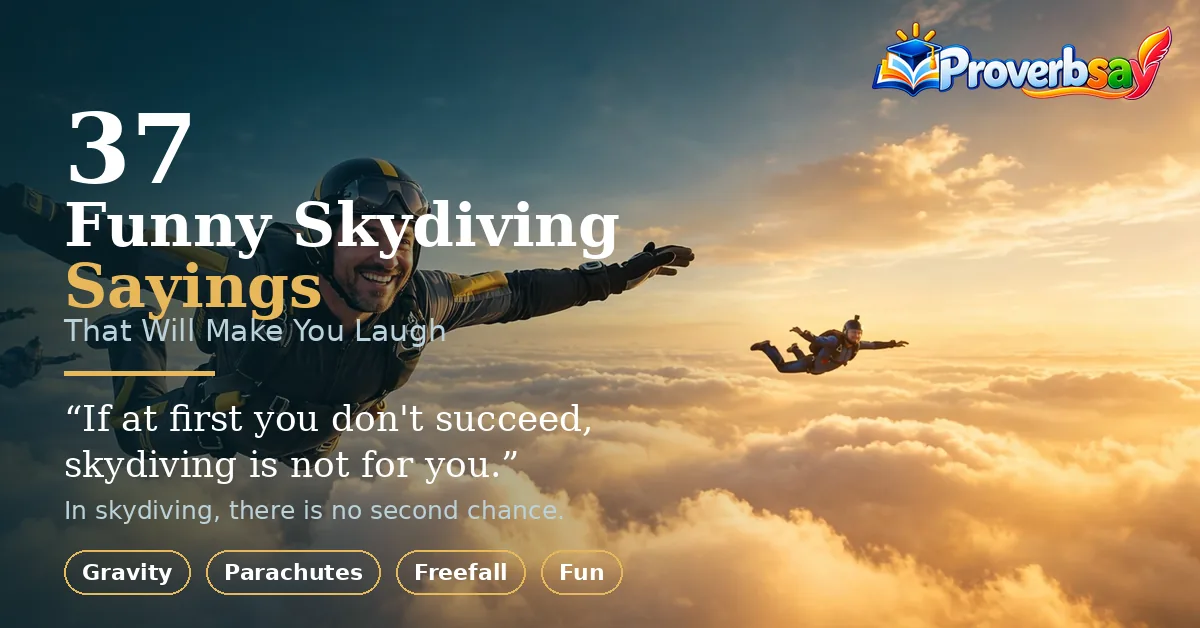
2. If at first you don’t succeed, skydiving is not for you.
Meaning:
Unlike most hobbies, skydiving gives you no second chance if you fail.
What It Really Means:
The joke twists the old advice to “try, try again.” In most things, failing once is fine. In skydiving, the stakes are rather higher. The humour comes from stating a deadly serious fact as if it were a casual warning.
Example:
He failed his driving test three times and joked that at least he had not chosen skydiving. After all, if at first you don’t succeed, skydiving is not for you.
When to Use It:
Use it when someone talks about trying again after a failure, and you want a dark little joke.
Lesson:
Some activities reward persistence; others reward getting it right the first time.
Origin:
Often credited to the comedian Steven Wright.
3. You don’t need a parachute to go skydiving — you only need one to go skydiving twice.
Meaning:
Anyone can jump out of a plane once, but only a parachute lets you do it again.
What It Really Means:
The joke works by splitting skydiving into two different things: the jump, and the landing. The jump needs only courage.
The second jump needs a working parachute. It is the same joke as the one above, told from a different angle.
Example:
The instructor smiled as the nervous student asked about the parachute. “You don’t need one to go skydiving,” he said. “You only need one to go skydiving twice.”
When to Use It:
Use it to make a nervous first-timer laugh before the jump.
Lesson:
Never joke about safety with someone who is genuinely scared — save this one for people who are already laughing.
4. What’s the hardest thing about skydiving? The ground.
Meaning:
The jump is easy; the landing is the hard part.
What It Really Means:
The joke answers its own question with the most obvious danger of all. The ground is not a small detail.
It is the whole problem. The humour is in the understatement, as if the ground were a minor inconvenience.
Example:
When the children asked their father what was hard about skydiving, he laughed and said, “What’s the hardest thing about skydiving? The ground.”
When to Use It:
Use it as a quick one-liner when someone asks what skydiving is really like.
Lesson:
Respect the landing more than the leap; finishing well matters most.
5. Skydiving: where the ground is optional.
Meaning:
For a few wonderful minutes, the ground does not matter at all.
What It Really Means:
The joke treats the ground as an optional extra, like a topping on a pizza. In freefall, you are flying, and the earth feels far away and unimportant. The humour comes from pretending that gravity is a choice.
Example:
She posted a photo of herself in freefall with the caption, “Skydiving: where the ground is optional.” Her friends loved it.
When to Use It:
Use it as a caption for a freefall photo, when the joy of flying is the point.
Lesson:
Enjoy the moments when your worries feel far below you.
6. Gravity: not just a good idea, it’s the law.
Meaning:
Gravity is not a suggestion; it is a rule you cannot break.
What It Really Means:
The joke borrows the language of road signs and courtrooms. Gravity is treated like a traffic law that everyone must obey. Skydivers know this law better than anyone, because they test it every time they jump.
Example:
He tried to explain why his hat flew off during the jump, and his friend simply said, “Gravity: not just a good idea, it’s the law.”
When to Use It:
Use it whenever something falls, drops, or lands somewhere it should not.
Lesson:
Work with the laws of nature, not against them — especially at 10,000 feet.
Gravity Jokes
Gravity is the skydiver’s oldest enemy and best friend. These six sayings are all about that strange relationship.
7. Gravity? Never heard of her.
Meaning:
I am pretending that gravity does not exist, while falling through the sky.
What It Really Means:
The joke personifies gravity as a woman the speaker has never met. It is a playful way of saying, “I am flying, and I refuse to admit that anything is pulling me down.” The humour is pure denial, delivered with confidence.
Example:
Midway through her freefall, she shouted at the camera, “Gravity? Never heard of her!” The video went viral among her friends.
When to Use It:
Use it as a caption for a photo taken in mid-air, when confidence is the joke.
Lesson:
Confidence is fun, but remember that gravity has heard of you.
8. Gravity: 1. My dignity: 0.
Meaning:
Gravity won the match, and my dignity lost completely.
What It Really Means:
The joke is written like a sports score. Gravity scored one point.
Dignity scored none. It describes the moment when a graceful jump turns into a clumsy landing, a tangled parachute, or a face full of wind.
Example:
He landed on his backside in front of the whole group and posted the video with the caption, “Gravity: 1. My dignity: 0.”
When to Use It:
Use it after a clumsy landing or an embarrassing fall, when laughing at yourself is the best option.
Lesson:
Keep score with humour, and a bad landing becomes a good story.
9. I skydive because punching gravity in the face feels amazing.
Meaning:
Skydiving feels like fighting gravity and winning, and that feeling is wonderful.
What It Really Means:
The joke turns a skydive into a boxing match. Gravity is the opponent, and the skydiver is landing punches by falling on purpose. It is a boast, a joke, and a celebration of courage all at once.
Example:
When his friends asked why he spent his weekends jumping out of planes, he said, “I skydive because punching gravity in the face feels amazing.”
When to Use It:
Use it when someone asks why you love skydiving, and you want a bold, funny answer.
Lesson:
Choose a thrill that makes you feel strong, and enjoy the victory.
10. Gravity and I have an understanding.
Meaning:
Gravity and I have an agreement: it pulls me down, and I enjoy the ride.
What It Really Means:
The joke pretends that gravity is a friend with whom the speaker has made a deal. The deal is simple.
Gravity does its job, and the skydiver enjoys the fall. The humour is in the calm, businesslike tone about something so wild.
Example:
Before his tenth jump, he told the new students, “Don’t worry. Gravity and I have an understanding.” They laughed, and their nerves eased a little.
When to Use It:
Use it to sound calm and confident before a jump, or as a caption for a relaxed freefall photo.
Lesson:
Fear shrinks when you treat it like an old friend instead of an enemy.
11. I believe I can fly, but landing might be an issue.
Meaning:
The flying part is wonderful; the stopping part is the problem.
What It Really Means:
The joke starts with a famous song lyric about believing you can fly, and then adds a very practical worry. Believing is easy.
Landing without injury is the hard part. The humour is in the gap between the dream and the ground.
Example:
She sang “I believe I can fly” on the way up in the plane, then added, “but landing might be an issue,” and the whole group laughed.
When to Use It:
Use it when you feel brave about starting something but unsure about finishing it.
Lesson:
Plan your landing as carefully as your leap.
12. Falling is easy — landing is the tricky part.
Meaning:
Anyone can fall, but landing well takes skill and practice.
What It Really Means:
The joke states a plain truth. Falling needs no training. Gravity does all the work.
Landing needs timing, control, and a working parachute. The humour is in how casually it states something so important.
Example:
The instructor told the class, “Falling is easy. Landing is the tricky part. So today we practise landings, not falling.”
When to Use It:
Use it when someone makes a difficult thing sound simple, and you want to add the honest warning.
Lesson:
Practise the ending, not only the beginning.
Freefall Faces and Screaming
Freefall does strange things to a human face. These six sayings are about the noise, the wind, and the face you pull at 120 miles per hour.
13. My face during freefall should be studied by science.
Meaning:
My face looked so strange during freefall that scientists should investigate it.
What It Really Means:
The joke is about what the wind does to a face at 120 miles per hour. Cheeks flap, lips stretch, and eyes water.
The result is a face nobody would recognise. Pretending that science should study it turns an embarrassing photo into a proud joke.
Example:
She looked at her freefall photo, laughed, and posted it with the caption, “My face during freefall should be studied by science.”
When to Use It:
Use it as a caption for an unflattering freefall photo, when honesty is funnier than pride.
Lesson:
Laugh at your own photos before anyone else can.
14. I screamed for the first ten seconds and smiled for the rest.
Meaning:
I was terrified at first, and then I loved every second of it.
What It Really Means:
The joke tells the whole story of a first jump in one sentence. The first ten seconds are pure fear.
Then the fear turns into joy, and the screaming turns into smiling. It is honest, and every skydiver recognises it.
Example:
When her mother asked how the jump went, she said, “I screamed for the first ten seconds and smiled for the rest.” Her mother finally understood why she wanted to go again.
When to Use It:
Use it when you describe your first jump to someone who has never tried it.
Lesson:
Fear often lasts only ten seconds; the joy lasts much longer.
15. I’m not crying. It’s just the wind. At 120 mph. On my face.
Meaning:
My eyes are watering because of the wind, not because I am scared.
What It Really Means:
The joke is a denial that nobody believes. Of course the eyes water at 120 miles per hour.
Of course the jumper is also a little scared. The humour is in the stubborn insistence that it is only the wind.
Example:
He landed with tears streaming down his face and said, “I’m not crying — it’s just the wind at 120 mph on my face.” Everyone laughed, because they knew it was both.
When to Use It:
Use it after a windy jump, or whenever your eyes water and you want a funny excuse.
Lesson:
Blame the wind when you need to, but admit the fear to yourself.
16. My freefall face is not my best angle.
Meaning:
I do not look my best while falling through the sky at high speed.
What It Really Means:
The joke is a gentle warning about freefall photos. Nobody looks elegant when the wind is reshaping their face. The humour is modest and self-aware: the speaker knows the photo is terrible and posts it anyway.
Example:
She posted the wildest freefall photo with the caption, “My freefall face is not my best angle.” It got more likes than any of her careful portraits.
When to Use It:
Use it as a caption for a freefall photo, when the picture is more honest than flattering.
Lesson:
Post the real photo; the funny one is always more popular.
17. I left my stomach at 10,000 feet.
Meaning:
The jump left my stomach behind, because of the sudden drop.
What It Really Means:
The joke describes the strange feeling in your stomach when you fall. It feels as if your stomach has stayed up in the plane while the rest of you is falling. The humour is in the picture of a stomach floating alone at 10,000 feet.
Example:
After his first jump, he clutched his belly and said, “I think I left my stomach at 10,000 feet.” The instructor nodded and said it would catch up by lunch.
When to Use It:
Use it after a first jump or a rollercoaster, when your stomach still feels strange.
Lesson:
Your stomach always catches up eventually, so enjoy the ride.
18. Wind in my hair — all of it, in every direction.
Meaning:
The wind blew my hair everywhere at once during the fall.
What It Really Means:
The joke plays on the romantic image of wind in the hair. In a car advert, the hair flows beautifully in one direction.
In freefall, it flies in every direction at once. The humour is in the gap between the dream and the reality.
Example:
Her hair stood straight up in the freefall photo, and she captioned it, “Wind in my hair — all of it, in every direction.”
When to Use It:
Use it as a caption for a wild-haired freefall photo.
Lesson:
Tie your hair back before the jump, and laugh about it after.
Parachute Humour
The parachute is the most important part of the whole adventure, so naturally it gets the most jokes. These six sayings are about the piece of fabric between you and the ground.
Skydiving is the sport of jumping from an aircraft and landing safely with a parachute, and every joke below depends on that one small piece of equipment working perfectly.
19. A parachute is just a fancy umbrella for people who hate walking down.
Meaning:
A parachute is really an umbrella, redesigned for people who would rather fall than walk.
What It Really Means:
The joke shrinks a parachute down to an everyday object. An umbrella keeps rain off you. A parachute keeps the ground off you.
Both open above your head. The humour is in treating a life-saving device like a fashion accessory.
Example:
When his grandmother asked what a parachute was, he said, “It’s just a fancy umbrella for people who hate walking down.” She laughed and told him to be careful anyway.
When to Use It:
Use it when you explain skydiving to someone who has never seen a parachute.
Lesson:
Respect the equipment, even when you joke about it.
20. I trust my parachute more than my Wi-Fi.
Meaning:
My parachute is more reliable than my internet connection.
What It Really Means:
The joke compares two things that should both work every time, but only one does. Wi-Fi drops at the worst moment.
A parachute, packed properly, does not. The humour is in trusting a piece of fabric more than modern technology.
Example:
He posted a photo of his packed parachute with the caption, “I trust my parachute more than my Wi-Fi.” His friends, who knew his internet problems, agreed completely.
When to Use It:
Use it when your Wi-Fi fails again, or as a caption for a photo of your parachute.
Lesson:
Trust the things that have been tested, not the things that only promise to work.
21. My parachute opened. Best surprise of my life.
Meaning:
The parachute opened, and I was more relieved than I expected to be.
What It Really Means:
The joke pretends that the parachute opening was a surprise, as if it might not have happened. Every skydiver knows it should open.
Every skydiver is also quietly glad when it does. The humour is in the understatement of that relief.
Example:
Under the open canopy, floating quietly above the fields, she thought, “My parachute opened. Best surprise of my life.” Then she laughed at herself.
When to Use It:
Use it after a jump, when the relief of a safe landing turns into a joke.
Lesson:
Never take a working parachute for granted, even on your hundredth jump.
22. My love life is like a parachute — if it doesn’t open, things go downhill fast.
Meaning:
My love life is like a parachute: when it fails, everything falls apart quickly.
What It Really Means:
The joke compares a failed parachute with a failed relationship. Both start with hope and end with a rapid descent. The humour is dark but honest, and it works because everyone understands both kinds of falling.
Example:
After his third break-up in a year, he sighed and said, “My love life is like a parachute — if it doesn’t open, things go downhill fast.” His friends laughed, and then they took him for coffee.
When to Use It:
Use it when a relationship ends badly and you need a joke to lighten the mood.
Lesson:
Check your parachute before you jump, and check your relationship before you commit.
23. Parachutes are nature’s way of saying, “Slow down, hotshot.”
Meaning:
A parachute is nature’s reminder to slow down before you hit the ground.
What It Really Means:
The joke gives nature a voice, and the voice is gently mocking. “Hotshot” is a nickname for someone who thinks they are fearless and brilliant. The parachute is nature’s way of telling that person to calm down.
Example:
He bragged about his perfect freefall style, and the instructor pointed at his parachute and said, “Parachutes are nature’s way of saying, ‘Slow down, hotshot.'”
When to Use It:
Use it when someone is showing off about a risky adventure.
Lesson:
Let the parachute slow you down, in the air and in life.
24. Why do birds sing? Because they don’t have to pack after they land.
Meaning:
Birds have an easier life than skydivers, because they never have to fold a parachute.
What It Really Means:
The joke answers a sweet question with a very practical complaint. Packing a parachute is long, fiddly work.
Birds simply land and fly away. The humour is in the envy of a creature that never has to do chores after flying.
Example:
After an hour of folding his parachute on the grass, he watched a bird fly past and said, “Why do birds sing? Because they don’t have to pack after they land.”
When to Use It:
Use it while packing a parachute, when the job feels long and the birds look free.
Lesson:
Every joy has its chores; pack the parachute with the same smile you jumped with.
Before the Jump: Nerves and Excuses
The funniest moments often happen before the jump, when nerves meet excuses. These six sayings are about that waiting time.
25. They told me not to jump to conclusions, so I jumped out of a plane instead.
Meaning:
I took the advice not to jump to conclusions very literally, and jumped out of a plane instead.
What It Really Means:
The joke is a pun. “Jump to conclusions” means deciding too quickly.
The speaker pretends they misunderstood the advice and chose a different kind of jumping. The humour is in the wordplay, and in the idea that jumping out of a plane is somehow the safer option.
Example:
When the teacher said, “Don’t jump to conclusions,” the student replied, “Don’t worry. I jumped out of a plane instead.” The class laughed, and the teacher gave up.
When to Use It:
Use it when someone tells you not to jump to conclusions, and you want a clever reply.
Lesson:
Wordplay is welcome, but think before you jump, in either sense.
26. I told my boss I needed a day off to fall from the sky.
Meaning:
I asked for leave from work so that I could go skydiving.
What It Really Means:
The joke is in the honest reason for the day off. Most people ask for leave for a wedding or a doctor’s appointment.
This person asked for leave to fall from the sky. The humour is in the plain, factual way an absurd request is made.
Example:
He filled in the leave form with the reason, “I need a day off to fall from the sky.” His boss approved it, mostly out of curiosity.
When to Use It:
Use it when you book a skydive on a workday, and someone asks why you need the time off.
Lesson:
Be honest about your adventures; a good boss will admire the courage.
27. Sorry, Mom, I promise I’ll make better choices. Eventually.
Meaning:
I know my mother worries about my skydiving, but I am not going to stop yet.
What It Really Means:
The joke is an apology that is not really an apology. The speaker says sorry, promises better choices, and then adds “eventually,” which means “not today.” It is the classic message from an adult child to a worried parent.
Example:
She sent her mother a photo from the plane with the caption, “Sorry, Mom, I promise I’ll make better choices. Eventually.” Her mother replied with three worried emojis and one laughing face.
When to Use It:
Use it as a caption when you post a skydiving photo that will worry your parents.
Lesson:
Tell your family before you jump, and let them worry a little less.
28. Paid money to fall out of the sky. Best purchase ever.
Meaning:
I spent money to jump out of a plane, and it was worth every penny.
What It Really Means:
The joke is about the strange economics of skydiving. Most people pay money to avoid falling.
Skydivers pay money to fall on purpose. Calling it the best purchase ever turns a silly expense into a proud choice.
Example:
He looked at his bank statement, saw the skydive payment, and smiled. “Paid money to fall out of the sky. Best purchase ever.”
When to Use It:
Use it as a caption for a skydiving photo, or when someone asks whether the jump was worth the money.
Lesson:
Spend money on experiences that make you feel alive, not only on things.
29. I went skydiving once. Now I tell everyone I’m basically Superman.
Meaning:
One skydive was enough to make me feel like a superhero forever.
What It Really Means:
The joke is about the pride that follows a first jump. One jump does not make anyone Superman. But the feeling of flying, even for a minute, is so powerful that the jumper wants to tell the whole world about it.
Example:
At every party for a month, he began his stories with, “I went skydiving once.” His friends joked that he now thought he was basically Superman.
When to Use It:
Use it when a friend will not stop talking about their one and only skydive.
Lesson:
Enjoy the pride, but let other people discover your adventures too.
30. Skydiving: because adulting is hard and falling is easy.
Meaning:
I go skydiving because being a grown-up is difficult, and falling out of a plane is simple by comparison.
What It Really Means:
The joke compares two kinds of difficulty. Adult life means bills, meetings, and responsibilities.
Falling means letting go and enjoying the ride. The humour is in choosing the easier option, even though it looks like the braver one.
Example:
After a long week of meetings and deadlines, she booked a skydive and said, “Skydiving: because adulting is hard and falling is easy.”
When to Use It:
Use it when adult life feels heavy and you need a funny reason to escape for a day.
Lesson:
A short escape can make adult life easier to face again.
After the Jump and Skydiver Life
Landing safely changes you. These seven sayings are about the joy, the pride, and the new life that begins after the jump.
31. Free falling and looking fabulous.
Meaning:
I am falling through the sky and I look wonderful doing it.
What It Really Means:
The joke is a boast, delivered as if falling through the air were a fashion show. Freefall is not usually fabulous.
Hair flies, cheeks flap, and goggles fog up. Claiming to look fabulous anyway is the whole point of the joke.
Example:
She posted her freefall photo with the caption, “Free falling and looking fabulous.” Her friends replied that the wind had done wonders for her hair.
When to Use It:
Use it as a caption for a freefall photo, when confidence matters more than accuracy.
Lesson:
Confidence makes any photo fabulous, even one taken at 120 miles per hour.
32. I just levelled up in the game of life.
Meaning:
Skydiving felt like reaching a new level in a video game.
What It Really Means:
The joke borrows the language of video games. In a game, levelling up means you have beaten a challenge and gained new powers. A skydive feels the same way: you faced fear, survived it, and came out stronger.
Example:
After his first solo jump, he texted his friends, “I just levelled up in the game of life.” They replied with a row of trophy emojis.
When to Use It:
Use it after any big personal achievement, especially your first jump.
Lesson:
Treat every brave act as a new level, and keep playing the game.
33. Just casually defying gravity, no big deal.
Meaning:
I am casually breaking the laws of physics, as if it were nothing special.
What It Really Means:
The joke is in the word “casually.” There is nothing casual about falling from a plane. Pretending it is no big deal is a boast disguised as modesty. It is the skydiver’s version of saying, “Oh, this old thing?”
Example:
He posted a photo of himself in freefall with the caption, “Just casually defying gravity, no big deal.” His friends knew it was a very big deal indeed.
When to Use It:
Use it as a caption for a freefall photo, when you want to sound relaxed about something extraordinary.
Lesson:
Stay humble about your adventures, but enjoy the boast a little.
34. The sky’s the limit — literally.
Meaning:
The old saying about the sky being the limit is literally true for a skydiver.
What It Really Means:
The joke takes a common expression and makes it real. “The sky’s the limit” usually means there is no limit to what you can do.
For a skydiver, the sky is the actual place where the adventure begins. The humour is in the word “literally.”
Example:
When her coach asked how high she wanted to go, she laughed and said, “The sky’s the limit — literally.”
When to Use It:
Use it when someone uses the phrase “the sky’s the limit” around a skydiver.
Lesson:
Some sayings become truer when you take them literally.
35. Blue skies!
Meaning:
Have a wonderful jump, and may the sky be clear and blue for you.
What It Really Means:
The picture is simple: a blue sky means good weather, safe jumping, and a beautiful view. Skydivers say “Blue skies!” to each other as a greeting, a farewell, and a wish for a safe jump, all in two words. It is the friendliest saying in the whole sport.
Example:
As the group walked to the plane, they bumped fists and said, “Blue skies!” It was their way of wishing each other a safe and happy jump.
When to Use It:
Use it to greet another skydiver, or to wish someone well before a jump.
Lesson:
A kind wish costs nothing and means everything before a jump.
Origin:
A traditional greeting among skydivers around the world.
36. Fell from the sky. Still looked fabulous.
Meaning:
I fell from the sky and somehow still looked wonderful afterwards.
What It Really Means:
The joke is a sequel to the earlier boast about looking fabulous in freefall. This time the jumper has landed, survived, and is still claiming to look fabulous. The humour is in the confidence that survives the fall.
Example:
She landed, took off her helmet, shook out her hair, and posted a photo with the caption, “Fell from the sky. Still looked fabulous.”
When to Use It:
Use it as a caption for a landing photo, when the jump is over and the pride remains.
Lesson:
Land well, and the story tells itself.
37. I’ve jumped so many times, the clouds wave at me now.
Meaning:
I have skydived so often that even the clouds know me.
What It Really Means:
The joke is about experience. A beginner waves at the clouds.
An expert jokes that the clouds wave back. It is a boast about the number of jumps, told with a smile rather than with pride.
Example:
On his hundredth jump, the old skydiver laughed and said, “I’ve jumped so many times, the clouds wave at me now.” The younger jumpers laughed and asked for his advice.
When to Use It:
Use it when an experienced skydiver wants to joke about how many jumps they have made.
Lesson:
Experience is earned one jump at a time, so keep jumping.
How to Use Funny Skydiving Sayings
These sayings work best when the moment is light and everyone is already smiling. Use them to celebrate, to caption a photo, or to calm nervous laughter, never to mock someone who is genuinely scared.
In conversation, keep the tone warm. A joke about gravity lands well with a friend who has just jumped. The same joke can sound careless to someone who is terrified before their first jump, so read the room first.
In captions, pick one saying that matches the photo. A freefall photo needs a freefall joke.
A landing photo needs a landing joke. One good line beats five average ones.
In writing, these sayings work well in cards, speeches, and social media posts. They are especially useful when you write about adventure, courage, or bucket-list dreams.
For shorter sayings to use alongside these, see our collection of short proverbs with meanings and examples.
Common Mistakes to Avoid
- Joking about safety with a scared first-timer. Some of these sayings joke about parachutes failing or landings going wrong. They are funny only when everyone is relaxed. Never use them on someone who is genuinely frightened.
- Using too many sayings at once. One saying in a caption is strong. Five sayings in a row make the post sound like a list. Let each saying breathe, with its own photo or moment.
- Claiming a famous line as your own. A few of these sayings come from comedians and writers, like Steven Wright. Enjoy them, share them, but do not present someone else’s joke as your own words.
- Forgetting the real risk. Skydiving is fun, but it is also a serious sport with real training and real rules. The jokes celebrate the thrill, but they should never make light of the safety checks that keep jumpers alive.
- Using a saying that does not match the photo. A parachute joke under a freefall photo confuses the reader. Match the saying to the moment, and the humour will land properly.
Frequently Asked Questions
What is the funniest skydiving saying?
“If at first you don’t succeed, skydiving is not for you” is the most famous, and it is often credited to the comedian Steven Wright. “You don’t need a parachute to go skydiving — you only need one to go skydiving twice” is almost as popular, and both appear in conversation, captions, and speeches everywhere.
What does “blue skies” mean in skydiving?
It is the traditional greeting and farewell among skydivers. It means “have a wonderful jump” and “may the sky be clear and blue for you.” Skydivers say it before a jump, after a landing, and whenever they meet another skydiver.
Can I use these sayings as Instagram captions?
Yes, that is exactly what most of them are for. Pick one saying that matches your photo, keep it short, and add it as your caption. One good line works better than five, and a funny caption always gets more attention than a plain one.
Is skydiving really as dangerous as the jokes suggest?
Skydiving carries real risk, but modern equipment, strict training, and tandem jumps with experienced instructors make it far safer than the jokes suggest. The humour comes from the danger, but the safety record comes from careful rules, good gear, and professional instructors.
What should I say to someone before their first skydive?
Keep it light and kind. “Blue skies!” is perfect, or “I screamed for the first ten seconds and smiled for the rest.” Avoid jokes about parachutes failing or landings going wrong. A nervous first-timer needs encouragement, not a reminder of what could go wrong.
Conclusion
Skydiving is a strange and wonderful thing to do.
You pay money, climb into a plane, and jump out of it on purpose. Then you fall, you fly, and you land with a story that nobody else in the room can match.
The sayings in this guide are the jokes skydivers tell about that story. They laugh at gravity, at parachutes, at screaming faces, and at the strange pride of falling from the sky on purpose.
Choose one saying from this list that fits your jump. Learn it by heart, use it at the right moment, and let it remind you that the best adventures are the ones worth laughing about.
For more classic proverbs grouped by theme, explore our 50 proverbs with meaning collection, and keep falling, laughing, and landing safely.

Liam Derren is a passionate writer who shares insightful ideas, practical tips, and valuable information to help readers stay informed, explore new perspectives, and make smarter decisions.