
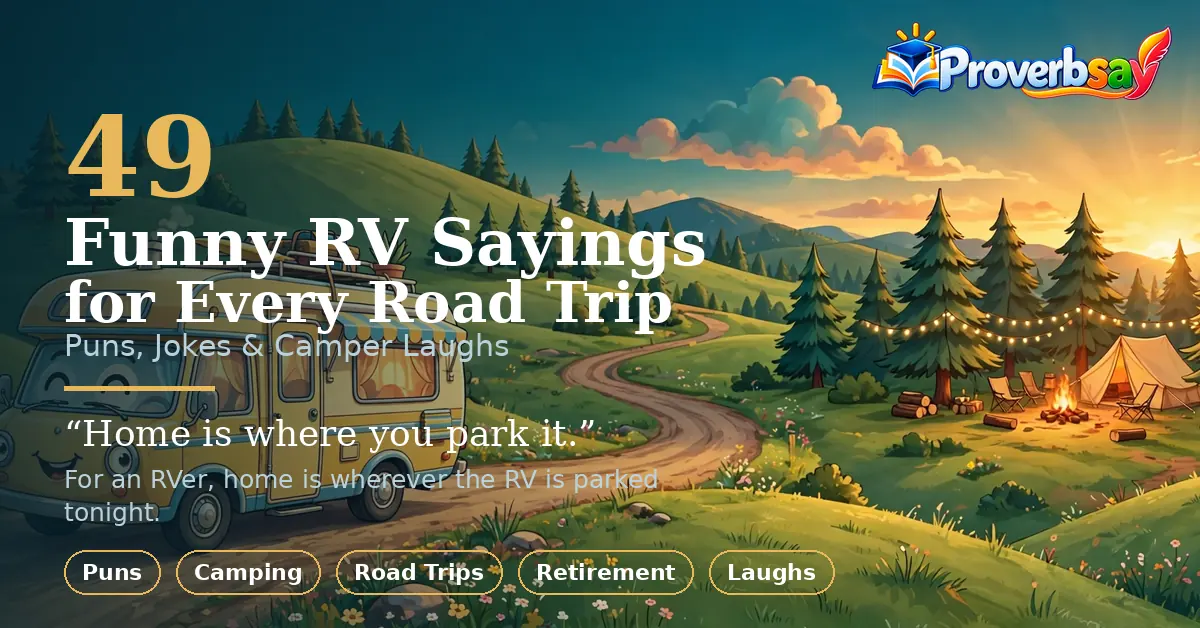
There is nothing quite like life on the road in an RV. The freedom is real, the views are wonderful, and the mishaps are unforgettable.
Anyone who has ever backed a trailer into a tight campsite, emptied a black tank, or run out of level ground knows the truth: RV life is funny, whether you plan it or not.
In this guide, you will find 49 funny RV sayings, from classic puns to “you might be an RVer if” jokes, grouped by theme. Each one comes with a plain meaning and a real-life example, so you can use them in captions, cards, campfire chats, and conversations.
You will also learn how to use RV humour well, which jokes to avoid, and how to turn a saying into the perfect caption for your next trip photo.
Quick Answer
Funny RV sayings are short, humorous lines about motorhome and camper life, full of puns about wheels, tanks, towing, and campgrounds. Below, you will find 49 of the best ones, with clear meanings and examples, grouped by theme, so you can find the perfect line for a caption, a mug, a sticker, or a laugh around the campfire.
What Are Funny RV Sayings?
Funny RV sayings are the jokes, puns, and one-liners that RVers share with each other. Some are printed on mugs and T-shirts. Others are shouted across campgrounds when someone parks badly.
They usually play on RV words: wheels, hitches, tanks, slides, hookups, and boondocking. The humour comes from the gap between the dream of the open road and the reality of a wobbling trailer and a full black tank.
These sayings are shared by weekend campers, full-time RVers, and retired snowbirds alike. They are a kind of secret language. If you laugh at them, you belong to the club.
If you enjoy humour like this, our collection of funny sayings has many more laughs in the same style.
Funny RV Puns About Life on Wheels
Puns are the fuel of RV humour. These eleven play on wheels, roads, and the simple joy of rolling along.
1. Home is where you park it.
Meaning:
For an RVer, home is not a fixed address. It is wherever the RV is parked tonight.
What It Really Means:
The saying turns the old line “home is where the heart is” into a joke about wheels. It captures the freedom of RV life: your home moves with you, so home can be a beach, a forest, or a Walmart car park.
Example:
When friends asked where she lived now, Karen pointed at her motorhome and smiled. “Home is where you park it, and tonight we are parked by the lake.”
When to Use It:
Use it on a photo of your RV in a beautiful spot, or when someone asks where home is.
Lesson:
Home is not a place on a map. It is wherever you feel at ease.
2. RV there yet?
Meaning:
A playful twist on the classic back-seat question, “Are we there yet?”, with RV in place of “are we”.
Example:
Three hours into the drive, the kids in the back started chanting, “RV there yet? RV there yet?” Their parents laughed, because they had asked the same question as children.
When to Use It:
Use it on a long drive, especially with children in the back seat.
Lesson:
The journey is part of the fun, even when it feels very long.
3. Life is better in an RV.
Meaning:
Life feels happier and freer when you are travelling in a motorhome.
Example:
After a stressful month at work, Mark printed this saying on a sticker and put it on his RV door. Every time he saw it, he remembered why he loved the road.
When to Use It:
Use it as a caption for a holiday photo, or on a gift for an RVer.
Lesson:
Sometimes the best cure for a busy life is a slow road and an open view.
4. Money can’t buy happiness, but it can buy an RV, and that’s kind of the same thing.
Meaning:
An RV cannot buy happiness directly, but the freedom and adventures it brings come very close.
What It Really Means:
The joke admits the truth and then cheerfully ignores it. Of course money cannot buy happiness. But it can buy a motorhome, and a motorhome can take you to sunsets, lakes, and campfires, which is close enough for most RVers.
Example:
When Dave bought his first used camper, his wife laughed and said, “Money can’t buy happiness, but it can buy an RV, and that’s kind of the same thing.” She was right. That summer was their happiest in years.
When to Use It:
Use it when you are justifying a big purchase, or teasing a friend who just bought an RV.
Lesson:
Spend your money on experiences, not only on things, and the happiness usually follows.
5. Wheel estate.
Meaning:
A pun on “real estate”, where the property has wheels instead of a foundation.
Example:
When the estate agent asked what kind of property they wanted, the couple said, “Wheel estate. The kind that moves.” They bought a fifth wheel the same month.
When to Use It:
Use it when joking about house prices, or about choosing an RV instead of a house.
Lesson:
A home on wheels can be a smarter investment in freedom than a house that never moves.
6. I’m wheely happy.
Meaning:
A pun on “really happy”, used to say that RV life makes you glad.
Example:
After a perfect sunset at the campground, Emma posted a photo with the caption, “I’m wheely happy right now.” Her friends replied with a row of laughing faces.
When to Use It:
Use it as a short caption for any happy RV photo.
Lesson:
Small jokes make good memories even better.
7. Adventure is out there — just follow the road.
Meaning:
The road itself will lead you to adventure, if you are willing to follow it.
Example:
When the family could not decide where to go, Dad simply turned the RV onto the coastal road and said, “Adventure is out there. Just follow the road.” They found a beach they had never heard of.
When to Use It:
Use it when plans fall apart and you decide to drive and see what happens.
Lesson:
You do not always need a plan. Sometimes the road is the plan.
8. Not all who wander are lost — some are just looking for a campsite.
Meaning:
A playful twist on the famous Tolkien line. RVers who wander are not lost; they are hunting for the perfect place to park.
What It Really Means:
The original line is about freedom and purpose. The RV version adds a practical joke: wandering is wonderful, but sooner or later you need a level pitch, a water hookup, and a place to sleep.
Example:
After circling the campground three times, Tom laughed and said, “Not all who wander are lost. Some are just looking for a campsite.” The ranger pointed them to the last free pitch.
When to Use It:
Use it when you are driving around looking for a place to stay.
Lesson:
Wandering is fine, but keep an eye on the fuel gauge and the daylight.
9. Eat, sleep, RV, repeat.
Meaning:
The simple daily rhythm of RV life: eat, sleep, drive, and do it all again tomorrow.
Example:
On the third day of their trip, the children made a sign for the RV window: “Eat, sleep, RV, repeat.” It stayed up for the whole holiday.
When to Use It:
Use it to describe a relaxed road trip with no fixed schedule.
Lesson:
The best holidays are often the simplest ones, repeated with joy.
10. Home is where the hookup is.
Meaning:
Home is wherever your RV can plug in water, electric, and sewer.
What It Really Means:
The joke plays on “home is where the heart is”, and on what an RVer really wants. A beautiful view is lovely, but a site with water, power, and a sewer connection is what makes a place feel like home.
Example:
After three nights without hookups, they pulled into a full-service site and Dad sighed happily. “Home is where the hookup is.”
When to Use It:
Use it when you finally reach a full-service campsite after days of roughing it.
Lesson:
Comfort is a luxury on the road, so enjoy a full hookup when you find one.
11. I followed my heart, and it led me to the RV park.
Meaning:
You let your feelings guide you, and they guided you straight to a campground.
What It Really Means:
The saying jokes that an RVer’s heart does not point to romance or adventure in the usual sense. It points to a quiet pitch, a campfire, and a good night’s sleep under the stars.
Example:
When her friends asked why she spent every holiday at the same RV park, Sue laughed. “I followed my heart, and it led me to the RV park.”
When to Use It:
Use it when someone asks why you keep returning to the same campsite.
Lesson:
Follow what makes you happy, even if it is just a quiet pitch by a lake.
You Might Be an RVer If…
Every hobby has its signs, and RVing has plenty. These ten jokes start with the same famous line, and each one describes a moment every RVer recognises.
12. You might be an RVer if “roughing it” means a site with only water and electric.
Meaning:
Your idea of roughing it has changed. A campsite without full hookups now feels like hardship.
Example:
When the campground had no sewer hookup, Paul sighed and said, “This is roughing it.” His friend, who grew up camping in a tent, laughed for five minutes.
When to Use It:
Use it when you catch yourself complaining about a campsite that most people would call luxury.
Lesson:
Comfort is relative, and RV life raises the bar very quickly.
13. You might be an RVer if your idea of a traffic jam is three RVs at a dump station.
Meaning:
You are so used to open roads that even a tiny queue feels like a traffic jam.
Example:
On a quiet Tuesday, three motorhomes waited at the dump station. “Look at this traffic,” joked the driver at the front. “Rush hour in the campground.”
When to Use It:
Use it when you are waiting in line at a campground facility.
Lesson:
After weeks on open roads, even a small queue feels crowded.
14. You might be an RVer if you measure distance in hours, not miles.
Meaning:
RVers talk about how long a drive takes, not how far it is, because towing changes everything.
What It Really Means:
A hundred miles in a car is a quick trip. A hundred miles in an RV, with a trailer, hills, and fuel stops, is half a day. RVers learn to think in hours, because hours are what the journey actually costs.
Example:
“How far is the lake?” asked the new camper. “About three hours,” said the old RVer. “It’s only ninety miles, but in an RV, we count in hours.”
When to Use It:
Use it when planning a route with someone new to RV travel.
Lesson:
Plan your trips in time, not in miles, and you will arrive relaxed.
15. You might be an RVer if you have ever used the phrase “just one more night” at least five times in a row.
Meaning:
You keep extending your stay because you love the place too much to leave.
Example:
The family planned to stay one night at the lakeside campground. They stayed six. Each morning someone said, “Just one more night,” and each morning everyone agreed.
When to Use It:
Use it when a short stay keeps growing longer.
Lesson:
The best trips are the ones you do not want to end.
16. You might be an RVer if you know the exact location of every Walmart that allows overnight parking.
Meaning:
You have memorised which shops welcome overnight RV parking, because it is part of the travel plan.
Example:
Driving through a new town at midnight, Sarah said, “There is a Walmart two exits ahead, and they allow overnight parking.” Her husband did not even ask how she knew.
When to Use It:
Use it when you are planning an overnight stop on a long drive.
Lesson:
Good RVers plan their stops, and they share the knowledge with each other.
17. You might be an RVer if “backing up” is a two-person job and a marriage test.
Meaning:
Reversing an RV into a pitch needs a spotter outside and a driver inside, and the shouting that follows can test any relationship.
What It Really Means:
The joke is famous because it is true. One person drives, the other waves their arms, and both of them think the other one is doing it wrong. Couples who survive backing up together can survive almost anything.
Example:
After a loud argument over hand signals, the couple finally parked the trailer. They laughed about it over dinner and agreed: “Backing up is a marriage test, and we passed, just barely.”
When to Use It:
Use it after a difficult parking job, once everyone has calmed down.
Lesson:
Agree on hand signals before you start reversing, and keep your voices calm.
18. You might be an RVer if your home has wheels and your garden is wherever you park.
Meaning:
Your whole house moves with you, and your view changes every time you park somewhere new.
Example:
Waking up to a mountain view one morning and a beach the next, Lisa said, “My garden changes every day. Not many people can say that.”
When to Use It:
Use it when you wake up somewhere beautiful.
Lesson:
A moving home gives you a new garden every time you travel.
19. You might be an RVer if you have a favourite dump station.
Meaning:
You know the cleanest, easiest dump station on your route, and you plan your journey around it.
Example:
“We are not stopping at that one,” said the driver firmly. “The one past the bridge is much better. It is my favourite.”
His wife nodded. She had heard this speech many times.
When to Use It:
Use it among experienced RVers who will understand at once.
Lesson:
Even the least glamorous parts of RV life have their favourites.
20. You might be an RVer if you pack for a weekend and still bring the whole house.
Meaning:
You cannot travel light, because everything in the house somehow ends up in the RV.
Example:
For a two-night trip, the family loaded the RV with four suitcases, a coffee machine, and a toolbox. “You might be an RVer if you pack for a weekend and still bring the whole house,” laughed the neighbour.
When to Use It:
Use it when the RV is packed so full that you can barely find the driver’s seat.
Lesson:
Pack light if you can, but laugh at yourself when you cannot.
21. You might be an RVer if your favourite petrol station is the one with room to turn around.
Meaning:
You judge fuel stops not by price, but by whether a big RV can get in and out safely.
What It Really Means:
A small station with cheap fuel is useless if you cannot turn around in it. Experienced RVers remember the stations with wide entrances, high canopies, and space to swing a trailer, and they plan their fuel stops around them.
Example:
Driving past a cheap station with a tiny forecourt, Dad said, “Not that one. My favourite is five miles ahead. It has room to turn around.”
When to Use It:
Use it when planning fuel stops on a long drive.
Lesson:
On the road, space to turn matters more than a few pence off the price.
Funny Sayings About Camping and Campfires
Camping is where RV humour meets the outdoors. These nine sayings are about tents, fires, s’mores, and the simple joys of sleeping under the stars.
22. Camping: where you spend a small fortune to live like a homeless person.
Meaning:
A joke, often credited to Dave Barry, about how campers pay a lot of money for an RV, gear, and fees, only to live without the comforts of home.
What It Really Means:
The humour is in the contrast. You buy an expensive motorhome, drive for hours, pay for a pitch, and then sleep in a small bed, cook on a tiny stove, and wash in a shared shower block. It is a strange way to spend money, and RVers love it anyway.
Example:
After adding up the cost of the trip, John laughed and said, “Camping: where you spend a small fortune to live like a homeless person.” Then he booked the next trip anyway.
When to Use It:
Use it when the costs of a camping trip add up and everyone needs a laugh.
Lesson:
The value of camping is not in comfort. It is in freedom, fresh air, and time together.
23. The s’more the merrier.
Meaning:
A pun on “the more the merrier”, using s’mores, the classic campfire treat of biscuit, chocolate, and melted marshmallow.
Example:
When a second family joined them at the fire, Mum handed out extra marshmallows and said, “The s’more the merrier!”
When to Use It:
Use it around a campfire when more people join the group.
Lesson:
Campfire treats taste better when they are shared.
24. I go camping because punching people is frowned upon.
Meaning:
A joke about using the peace of nature to escape the frustrations of everyday life.
Example:
After a hard week at the office, Emma packed the RV and said, “I go camping because punching people is frowned upon.” Her colleagues laughed, because they understood completely.
When to Use It:
Use it on a mug or a T-shirt, or when you need a break from people.
Lesson:
Nature is a healthier way to deal with stress than arguing with people.
25. Let’s go camping, just for the halibut.
Meaning:
A pun on “just for the hell of it”, replacing the swear word with a fish, to say you are going camping for no reason other than fun.
Example:
On Friday afternoon, Dad announced, “Let’s go camping, just for the halibut.” The children groaned at the pun and then ran to pack their bags.
When to Use It:
Use it when you decide on a spontaneous camping trip.
Lesson:
You do not need a reason to go camping. Fun is reason enough.
26. Happy campers.
Meaning:
People who are content and cheerful, especially on a camping trip.
What It Really Means:
The phrase is simple, but it carries a whole picture: people sitting by a fire, eating well, sleeping well, and enjoying each other’s company. To be a happy camper is to be at ease with simple pleasures.
Example:
After a week without phones, emails, or alarms, the whole family were happy campers. Nobody wanted to go home.
When to Use It:
Use it as a caption for a photo of smiling people at a campsite.
Lesson:
Happiness often comes from simple things: good company, fresh air, and a warm fire.
27. Our camping trips get a little in-tents.
Meaning:
A pun on “intense”, using “in tents”, to say that camping trips can be dramatic or full of strong feelings.
Example:
When the tent blew down in a storm and the children laughed instead of crying, Dad said, “Our camping trips get a little in-tents.” Everyone laughed, even in the rain.
When to Use It:
Use it when a camping trip becomes dramatic or chaotic.
Lesson:
A little chaos is part of the adventure, and it makes the best stories later.
28. I don’t need therapy. I just need to go camping.
Meaning:
A joke that says camping is the best cure for stress, better than any professional help.
Example:
After a month of deadlines, Sarah booked a campsite and told her friends, “I don’t need therapy. I just need to go camping.” Three days by the lake proved her right.
When to Use It:
Use it when you are stressed and dreaming of the outdoors.
Lesson:
Time in nature really does help. It is not a replacement for help when you need it, but it is a wonderful start.
29. Camping hair, don’t care.
Meaning:
A playful line that says you do not mind looking messy while camping, because comfort matters more than appearance.
Example:
With her hair in a messy bun and mud on her shoes, Jess posted a photo with the caption, “Camping hair, don’t care.” It got more likes than any of her polished photos.
When to Use It:
Use it as a caption for a relaxed, messy camping photo.
Lesson:
Camping is a holiday from appearances. Enjoy the freedom.
30. The campfire is my favourite television.
Meaning:
Sitting by a campfire is better entertainment than any TV show.
What It Really Means:
The joke compares the fire to a television: it glows, it crackles, and it holds your attention for hours. The difference is that the campfire comes with fresh air, good company, and no remote control to argue over.
Example:
As the flames danced and the marshmallows browned, Grandad said, “The campfire is my favourite television.” Nobody disagreed.
When to Use It:
Use it on a quiet evening by the fire, when nobody wants to go inside.
Lesson:
The simplest evenings are often the most entertaining ones.
Funny Sayings About Driving, Parking and Backing Up
The hardest part of RV life is moving the thing. These ten sayings are about driving, towing, and the famous art of parking.
A recreational vehicle can be anything from a small campervan to a huge motorhome, but every driver faces the same jokes: tight turns, low bridges, and campsites that look much bigger on the map.
31. Backing up an RV is a marriage tester.
Meaning:
Reversing a trailer into a pitch is so stressful that it tests even a strong relationship.
Example:
After twenty minutes of hand signals and raised voices, the trailer was finally in place. “Backing up an RV is a marriage tester,” said the wife, “and we just passed.” Her husband handed her a cold drink in celebration.
When to Use It:
Use it after a difficult reversing job, once the parking is done and everyone is smiling again.
Lesson:
Practise reversing in an empty car park before your first trip, and agree on signals first.
32. I brake for yard sales.
Meaning:
A joke that RVers will stop for anything interesting on the road, especially a bargain.
Example:
The RV slowed down for the third time that morning. “I brake for yard sales,” said Mum, and the children groaned as she pulled over again.
When to Use It:
Use it as a bumper sticker, or when you keep stopping on a road trip.
Lesson:
The road is full of surprises. Stopping for them is half the fun.
33. If we are rocking, don’t come a-knocking.
Meaning:
A cheeky campground saying that warns neighbours not to disturb an RV that is moving, because the people inside are busy.
What It Really Means:
The line is a joke about privacy in a very small, thin-walled home. RVers use it with a wink, usually on a sign on the RV door. It is funny because everyone in the campground understands it at once.
Example:
A new couple put a small wooden sign on their RV door that read, “If we are rocking, don’t come a-knocking.” The whole campground laughed, and the sign became a local legend.
When to Use It:
Use it on a door sign, never said seriously to a neighbour who needs help.
Lesson:
Keep the joke light, and remember that campgrounds are close communities.
34. My other car is a house.
Meaning:
A joke that the RV is both a vehicle and a home, so the “other car” is actually a house on wheels.
Example:
At the fuel station, a stranger asked about the motorhome. The driver grinned and said, “My other car is a house.” The stranger laughed and asked for a tour.
When to Use It:
Use it as a bumper sticker or a reply when someone admires your RV.
Lesson:
An RV is two things at once, and that is exactly the point.
35. Got lost? Good. That’s the plan.
Meaning:
Getting lost on an RV trip is not a failure. It is part of the adventure.
Example:
When the sat-nav failed and they ended up on a narrow country lane, Dad smiled and said, “Got lost? Good. That’s the plan.”
An hour later, they found a village with the best pie shop of the whole trip.
When to Use It:
Use it when a wrong turn leads somewhere unexpected and wonderful.
Lesson:
A wrong turn is only wrong if you refuse to enjoy it.
36. I can’t. I have plans. With my RV.
Meaning:
A polite excuse for missing an event, because the RV trip comes first.
Example:
When her friends invited her to a weekend party, Lisa replied, “I can’t. I have plans. With my RV.”
Nobody argued. They all knew the RV always won.
When to Use It:
Use it when you want to decline an invitation in a funny way.
Lesson:
Protect your travel time. Saying no to one thing means saying yes to the road.
37. Life is a highway, and I’m driving it in an RV.
Meaning:
A twist on the famous song line, saying that your road trip is your way of living life.
Example:
On the first morning of their retirement tour, the couple put on their favourite song and sang, “Life is a highway, and I’m driving it in an RV.” It became their trip anthem.
When to Use It:
Use it at the start of a long journey, or as a road-trip caption.
Lesson:
Treat the journey as the destination, and enjoy every mile.
38. You can’t run through a campground. You can only ran, because it’s past tents.
Meaning:
A pun on “past tense”, using “past tents”, to say that running through a campground is not allowed, so you can only have run there in the past.
What It Really Means:
The joke works on two levels. First, it is a grammar pun: “ran” is the past tense of “run”. Second, it is true: campgrounds have strict rules about running, for the safety of children and the peace of neighbours.
Example:
A child sprinted past the campfire, and a ranger called out, “No running!” An old RVer laughed and said, “You can’t run through a campground. You can only ran, because it’s past tents.”
When to Use It:
Use it with children, or with anyone who loves a grammar joke.
Lesson:
Campground rules exist for a reason, and a good pun makes them easier to remember.
39. My RV has two speeds: slow and scenic.
Meaning:
Your RV never hurries. It either crawls along, or it rolls slowly past beautiful views.
What It Really Means:
The joke admits that RVs are not built for speed, and turns that into a virtue. Slow means you see the scenery, the villages, and the sunsets that fast drivers miss completely.
Example:
A sports car overtook them for the third time, and Mum smiled. “My RV has two speeds: slow and scenic.”
When to Use It:
Use it when faster traffic passes you and you want to laugh instead of worry.
Lesson:
Slow travel shows you more than fast travel ever will.
40. My blind spot has a blind spot.
Meaning:
Your RV is so big that even the places you cannot see have places you cannot see.
Example:
Checking the mirrors for the fifth time before changing lanes, the driver muttered, “My blind spot has a blind spot.” His wife kept watch on the right side, just in case.
When to Use It:
Use it when changing lanes in a big RV, or when joking about how hard it is to see around one.
Lesson:
Take your time changing lanes, and always check twice.
Funny Sayings About Full-Time RV Life and Retirement
Some RVers never go home. These nine sayings are about living full-time on the road, retiring in an RV, and the freedom that comes with it.
41. Retired and living the RV dream.
Meaning:
A short saying that sums up the retirement dream: no office, no alarm clock, just the open road.
Example:
On the day he retired, Grandad hung a sign on his motorhome: “Retired and living the RV dream.” He drove off the next morning, and he has not stopped since.
When to Use It:
Use it on a retirement card for someone who loves travel.
Lesson:
Retirement is a chance to live the life you always talked about.
42. Home is where the Wi-Fi connects automatically.
Meaning:
A modern joke that home is wherever your devices remember the Wi-Fi password.
What It Really Means:
For full-time RVers, the old idea of home as a fixed place has changed twice. First the home started moving. Then the internet became the real anchor.
Wherever the Wi-Fi connects without asking, that is where you belong, at least for tonight.
Example:
Pulling into a campground, the laptop connected before the engine was even off. “Home is where the Wi-Fi connects automatically,” laughed the driver. “We must live here now.”
When to Use It:
Use it when you return to a favourite campsite and everything connects at once.
Lesson:
Home is less about walls and more about feeling connected and settled.
43. We are not lost. We are exploring.
Meaning:
A cheerful reply when someone points out that you have no idea where you are.
Example:
Three hours after leaving the main road, Mum asked where they were. Dad smiled and said, “We are not lost. We are exploring.”
The children cheered, because exploring sounded much better than lost.
When to Use It:
Use it whenever the route goes wrong but the mood stays good.
Lesson:
Call it exploring, and a wrong turn becomes an adventure.
44. The mountains are calling, and I must go… in my RV.
Meaning:
A twist on the famous John Muir line about the mountains, with an RV added for comfort.
Example:
When the office asked her to work one more weekend, Anna replied, “The mountains are calling, and I must go, in my RV.” She was on the road by Friday evening.
When to Use It:
Use it when nature is calling and you are ready to answer.
Lesson:
Answer the call of the wild, but take your own bed with you.
45. Born to RV, forced to work.
Meaning:
A joke that says you were made for the road, but work keeps getting in the way.
Example:
On Monday morning, Tom’s mug said it all: “Born to RV, forced to work.” His colleagues laughed, because they knew he counted the days until every trip.
When to Use It:
Use it on a mug, a T-shirt, or a Monday morning at work.
Lesson:
Work pays for the road, so enjoy the work and enjoy the road even more.
46. Less house, more home.
Meaning:
A small RV can feel more like home than a big house, because home is about freedom and people, not space.
What It Really Means:
The saying flips the usual idea that bigger is better. A big house brings bills, cleaning, and repairs.
A small RV brings sunsets, new neighbours, and a different view every week. Less house, the saying argues, can mean more home.
Example:
After selling their four-bedroom house, the couple moved into a motorhome. “Less house, more home,” they told their friends, and their friends could see it was true.
When to Use It:
Use it when someone asks why you downsized to an RV.
Lesson:
A home is measured in happiness, not in square metres.
47. I’d rather be camping.
Meaning:
A simple line that says you would prefer to be at a campsite than wherever you are now.
Example:
Stuck in a long meeting, Dan doodled a tent on his notepad and wrote underneath, “I’d rather be camping.” It became the motto of his whole team.
When to Use It:
Use it as a bumper sticker, a mug, or a quiet wish on a busy day.
Lesson:
Keep your next trip in mind, and even busy days feel shorter.
48. Adventure before dementia.
Meaning:
A funny but honest saying that urges people to travel while they still can, before age or illness makes it hard.
What It Really Means:
The humour is dark, and that is why it works. It says what many older RVers feel but rarely say aloud: do not wait for the perfect time, because the perfect time may never come. Travel now, while your health and your courage are with you.
Example:
At sixty-five, Margaret sold her house and bought a campervan. “Adventure before dementia,” she laughed, and drove to the coast the same week.
When to Use It:
Use it with older friends who keep delaying their travel dreams.
Lesson:
Do not wait for the perfect time to travel. The time is now, while you are able.
49. Retirement plan: drive until the map runs out.
Meaning:
Your retirement plan is simple: keep driving until there is no road left to explore.
What It Really Means:
The saying jokes that some retirees have no plan for settling down, no fixed destination, and no return date. The map is the plan, and the road is the retirement.
Example:
When the neighbours asked where they were moving to, the retired couple pointed at the RV and said, “Retirement plan: drive until the map runs out.”
When to Use It:
Use it on a retirement card for someone who loves the road.
Lesson:
Retirement is a chance to explore, not a time to sit still.
How to Use Funny RV Sayings
RV sayings work best when they fit the moment. A pun on a bumper sticker is perfect. The same pun shouted at a stranger in a campground may not be.
For captions, pick one saying that matches your photo. A picture of a sunset needs “Life is better in an RV”. A picture of a muddy campsite needs “Our camping trips get a little in-tents.”
For gifts, print a saying on a mug, a T-shirt, or a sticker. RVers love gifts that show the giver understands their life. A saying they have laughed at before is a safe choice.
For campfire chats, tell the saying as part of a story. “You might be an RVer if” jokes work best when you follow them with your own example. The story makes the joke yours.
For more short wisdom in the same cheerful style, see our collection of short proverbs with meanings and examples.
Common Mistakes to Avoid
- Using a joke that insults someone. Some RV humour is about other people: bad drivers, loud neighbours, or messy campers. Keep the jokes about situations and yourself, not about the people around you.
- Overusing the same saying. “Home is where you park it” is a great line, but it appears on a thousand mugs. If you use it for every photo, it stops being funny. Rotate your favourites.
- Forcing a pun into a serious moment. A joke about dump stations is perfect at a campfire. It is a poor choice at a funeral, a wedding, or a serious conversation about money.
- Printing a saying you have not checked. Some sayings are credited to famous people, like Dave Barry, and some are not. If you print a quote on a product, check who really said it first.
- Using humour to hide a real problem. If your RV has a leak, a joke about it will make everyone laugh, but it will not fix the leak. Laugh first, then fix the problem.
Frequently Asked Questions
What is the funniest RV saying?
“Home is where you park it” is the most loved, because it sums up the whole RV dream in six words. “RV there yet?” is the funniest for children, and “Backing up an RV is a marriage tester” gets the biggest laugh from couples who have lived through it.
Can I use these funny RV sayings on mugs and T-shirts?
Yes, most of these sayings are folk humour shared freely among RVers. Short puns and common lines are fine to print for personal use or gifts. If a saying is credited to a named author, such as Dave Barry, check the wording and the rights before selling products with it.
What does “boondocking” mean in RV sayings?
Boondocking means camping without hookups, usually on free public land or in a car park, with no water, electric, or sewer connection. It comes from the word “boondocks”, meaning a remote area. Many RV jokes are about boondocking, because it is the most adventurous way to camp.
Why do RVers love puns so much?
Puns fit RV life perfectly, because the language of RVing is full of words that sound like other words: wheel, road, camp, tent, and park. The jokes also build community. Sharing a pun is a quick way to say, “I understand your life, because I live it too.”
What is a good funny RV saying for a retirement card?
“Retired and living the RV dream” is the classic choice, and “Adventure before dementia” is the funniest for close friends with a sense of humour. For a gentler card, “Less house, more home” is warm, true, and easy to love.
Conclusion
RV life is funny because it is real. The road is beautiful, the views are wonderful, and the mishaps are part of the story.
These 49 sayings capture that spirit: the freedom of a moving home, the chaos of a tight campsite, and the joy of a campfire shared with good people.
Pick one saying that fits your life right now. Put it on a mug, use it as a caption, or tell it around the next campfire. Then get back on the road, because the next funny story is waiting at the next campsite.
For more laughs in the same style, explore our funny sayings collection, and keep the wheels turning and the jokes coming.

Liam Derren is a passionate writer who shares insightful ideas, practical tips, and valuable information to help readers stay informed, explore new perspectives, and make smarter decisions.